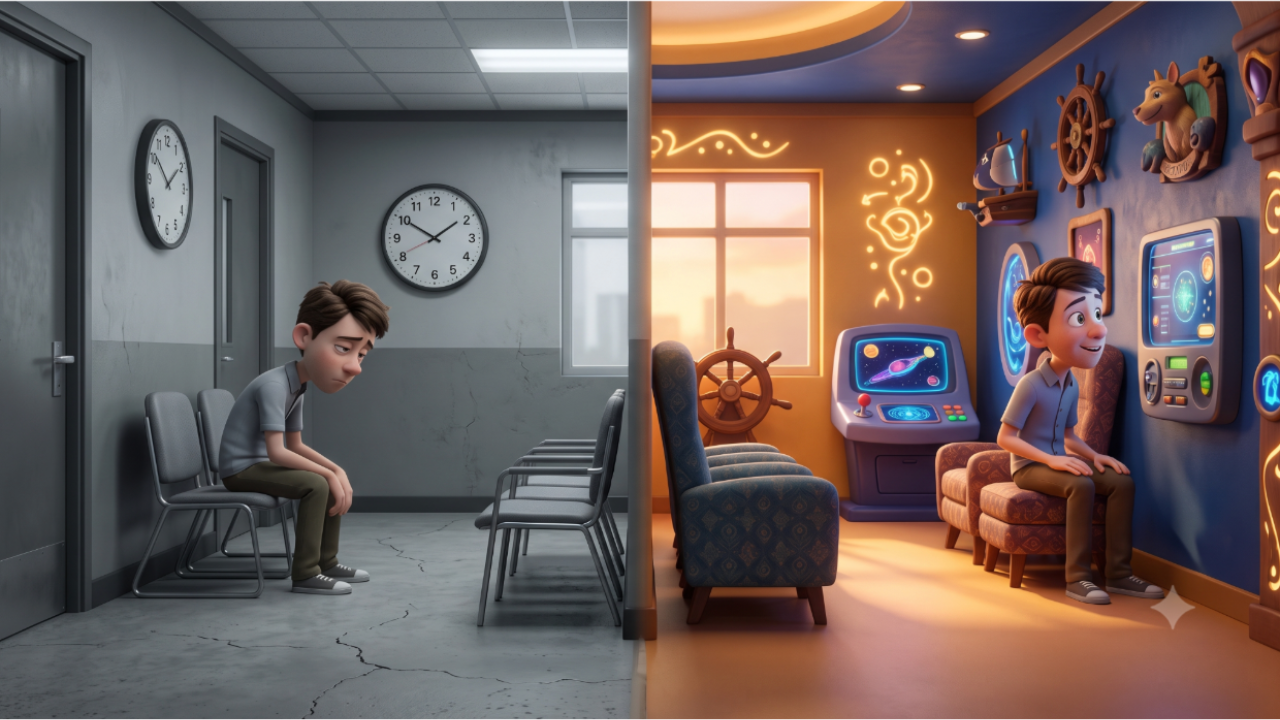
The Art of the Magical Queue:
How Disney Makes Waiting Feel Like Winning
There's a peculiar sort of madness that overtakes otherwise rational adults when they visit a Disney park.
They'll cheerfully stand in a queue for ninety minutes — in Florida heat that could melt a wax figure — to experience a ride that lasts roughly three minutes and forty-seven seconds. And here's the truly baffling part: they'll describe the entire experience as magical.
Meanwhile, those same people will write a scathing Yelp review if they have to wait eight minutes for a coffee.
What's going on here? Have Disney guests been hypnotised? Is there something in the churros?
The answer, as it turns out, has nothing to do with mind control and everything to do with one of Disney's most underappreciated business principles: the queue itself is part of the product.
Most businesses treat waiting as a necessary evil — dead time to be endured before the "real" experience begins. Disney treats it as prime real estate. An opportunity. A canvas.
And if you think this only applies to theme parks with billion-dollar budgets and armies of Imagineers, I have news for you: the same principles work in your business, whether you're running a dental practice, an accounting firm, or a plumbing company in Wolverhampton.
As Walt Disney himself once said, "Whatever you do, do it well." He didn't add "except for the boring bits." The boring bits were precisely where he saw the greatest opportunity.
Right then. Let's talk about turning your customers' waiting time into something they actually appreciate — without building a single roller coaster. 🪄
Key Takeaways From This Article:
- Occupied time feels shorter than unoccupied time — give waiting customers something valuable to do, read, or experience, and the clock seems to move faster.
- Anxiety is the enemy — uncertainty about how long the wait will be causes more stress than the actual waiting. Communicate clearly.
- Every moment is a moment of truth — the customer's experience of your business starts the moment they make contact, not when you deliver the product or service.
- The "queue" in your business might not look like a queue — it could be waiting for a quote, a callback, a delivery, or an appointment. Identify your hidden queues.
- Disney's "underpromise, overdeliver" approach works everywhere — tell customers 45 minutes and deliver in 35, and you've created unexpected delight.
- Physical environment speaks — your waiting area, your hold music, your email auto-responders all communicate whether you respect your customer's time.
- Interaction transforms dead time — a friendly check-in, useful information, or a small gesture of hospitality turns waiting into relationship-building.
- The principle isn't about budget — it's about intention — Disney spends millions on queue theming, but the core principle costs nothing to apply.
- Fill the pits before building the peaks — eliminating negative moments often matters more than creating spectacular ones.
- Time is the new currency — research shows that respecting customers' time is now the single most important factor in service perception.
Ninety Minutes in Line and We Loved Every Second of It

During our trip to Walt Disney World in October 2022, my wife and I found ourselves in the queue for Flight of Passage at Animal Kingdom.
Now, let me set the scene. It was approximately nine hundred degrees Fahrenheit outside. (I may be exaggerating slightly, but not by much.) The posted wait time was 95 minutes. My feet already hurt from walking approximately seven miles before lunch. And I am, as my wife regularly reminds me, "not exactly a patient person."
I should have been miserable.
Instead, I was wandering through what appeared to be a bioluminescent cave system from another planet, pointing at glowing alien flora like an overexcited child and saying things like "Look at that! Is that a neural interface station?"
The queue took us through ancient caves, past Pandoran plant specimens, into a high-tech research laboratory complete with an avatar floating in a tank of liquid. There were sounds, smells (yes, smells), and details so intricate that I kept stopping to examine them — much to the exasperation of the family behind us.
"You're holding up the queue," my wife observed drily.
"I'm experiencing the queue," I corrected her.
Here's what struck me afterward: I had no memory of waiting. None. We'd been in that line for over an hour and a half, and when I tried to recall the experience, all I remembered was discovery, anticipation, and wonder.
The ride itself was spectacular — genuinely one of the best theme park attractions on Earth. But the queue? The queue had done something remarkable. It had transformed what should have been the worst part of the experience into an essential part of the story.
I thought about this for days afterward. (My wife, bless her, had to endure quite a lot of "Do you realise what they did there?" commentary over dinner.)
Because here's the thing: every business has queues. Yours does too, even if they don't look like a switchback line with stanchions.
When a patient sits in your waiting room before their appointment — that's a queue.
When a customer waits three days for a quote — that's a queue.
When someone's on hold listening to tinny hold music — that's a queue.
When a client checks their tracking information for the fourth time that day — that's a queue.
The question isn't whether your customers wait. They do. The question is: what are you doing with that time?
What's happening in your customers' "queue" right now? Is it building anticipation, or is it building resentment?
The Queue Is the Product: How Disney Turns Dead Time Into Magic
You're strolling through Tomorrowland on a Saturday afternoon, past the sleek silver buildings and the optimistic 1960s vision of the future that Walt originally designed. You join the queue for Space Mountain — the classic indoor roller coaster that's been terrifying guests (in the best way) since 1975.
And immediately, you notice something. You're not just waiting. You're somewhere.
The queue area has been designed to feel like you're entering a futuristic spaceport. There are control panels. Departure boards. Windows that look out onto distant galaxies. The lighting shifts. The temperature drops. The sounds change.
By the time you board, you genuinely feel like you're about to launch into space. The wait hasn't just killed time — it's set the stage.
This is what Disney calls "queue theming" — and it's built on a foundation of cold, hard psychology.
David Maister, a Harvard Business School professor, published a paper in 1985 called "The Psychology of Waiting Lines" that became something of a bible for operations managers. His key insight was devastatingly simple: occupied time feels shorter than unoccupied time.
Read that again. It's the entire game.
When your brain has something to process — something to look at, think about, interact with — the subjective experience of time passing changes. Disney didn't need an academic paper to tell them this (they'd been doing it instinctively for years), but the research confirmed what their Imagineers understood intuitively.
The Disney Institute calls this part of their "Everything Speaks" philosophy. The idea is simple but radical: every single element of the guest environment communicates something. The queue isn't a holding pen. It's a communication channel.
Think about what your waiting experiences communicate to your customers. A tired waiting room with dog-eared magazines from 2019 says: "We don't really care about your time here." A dark, uninformative hold message says: "You're not important enough for us to think about this."
But a thoughtfully designed waiting experience? That says something entirely different.
Lee Cockerell, who ran Walt Disney World operations for over a decade, puts it perfectly in his book Creating Magic: "Every moment is a moment of truth." He's talking about the reality that customers don't separate the "waiting" from the "service." To them, it's all one experience.
Gus — the charmingly clumsy mouse from Cinderella who can never quite carry all the corn he's collected — reminds me of businesses that try to do too much during the main event while ignoring the waiting experience entirely. All that effort, scattered inefficiently. When you could be using the "idle" moments to do some of the heavy lifting.
Quick quiz time!
A customer has to wait 20 minutes in your waiting area before their appointment. Do you:
A) Provide a beige chair and a stack of pamphlets about various diseases, creating a vague sense of existential dread
B) Install a television playing 24-hour news, so they can marinate in anxiety about world events while they wait
C) Create an environment with comfortable seating, relevant and interesting reading material, clear signage about what happens next, and perhaps a staff member who checks in to confirm they're not forgotten
If you answered A or B, I admire your commitment to making customers question their life choices. If you answered C, you're thinking like Disney.
The Five Principles Behind the Magic: Why Disney Queues Actually Work
So there you are, in the queue for the Haunted Mansion at Magic Kingdom. You've entered the outdoor cemetery section — the "interactive queue" that Disney added in 2011. There's a pipe organ made of crypts that you can play. A fortune-telling book that responds when you touch it. Tombstones with terrible puns. (A personal favourite: "Dear Departed Brother Dave / He Chased a Bear into a Cave.")
Children are laughing. Adults are taking photos. Nobody is looking at their watch.
This isn't random. It's built on five principles that any business can apply:
Principle 1: Reduce Uncertainty
One of Maister's key findings was that anxiety makes waits feel longer. And nothing creates anxiety quite like uncertainty. "How long will this take?" "Have they forgotten about me?" "Am I even in the right queue?"
Disney attacks this relentlessly. Posted wait times everywhere. Cast members trained to give updates. Signs at key points. The My Disney Experience app showing real-time estimates. They don't just manage the queue — they manage the anxiety about the queue.
Here's the clever bit: Disney typically overestimates wait times by 10-15%. If the sign says 45 minutes and you wait 35, you feel delighted. You've beaten the system! You're winning! Same wait, completely different emotional experience.
Your business equivalent: How clearly do you communicate timelines? When a customer requests a quote, do they know when to expect it? When someone books an appointment, do they know how long it will take? Uncertainty breeds frustration. Clarity breeds confidence.
Principle 2: Give Time Value
Unoccupied time feels twice as long as occupied time. Disney fills their queues with things to see, do, and discover.
The Seven Dwarfs Mine Train queue has interactive gem-sorting stations. The queue for Millennium Falcon: Smugglers Run takes you through a detailed recreation of Hondo Ohnaka's operation, complete with AA-1 Verbobrain droids and cargo crates. The Play Disney Parks app offers location-specific games and trivia designed for exact queue lengths.
Now, you might be thinking, "But Andrew, I run an insurance agency. I can't exactly install a gem-sorting station."
Fair point. But you can provide useful content. Interesting information. Engaging communication. A financial services firm I worked with started sending an educational email series between when clients booked an initial consultation and when the meeting happened. Three emails, each providing genuinely useful information about what to prepare and what to expect. Client satisfaction scores went up significantly — not because the meetings got better, but because the waiting got better.
Principle 3: Use Human Connection
During longer waits, Disney cast members are trained to enter queues and interact with guests. They answer questions. They take family photos. They tell jokes. They make children feel special.
This serves multiple purposes. It signals that guests aren't forgotten. It creates positive micro-moments. And it gathers intelligence about guest mood and needs.
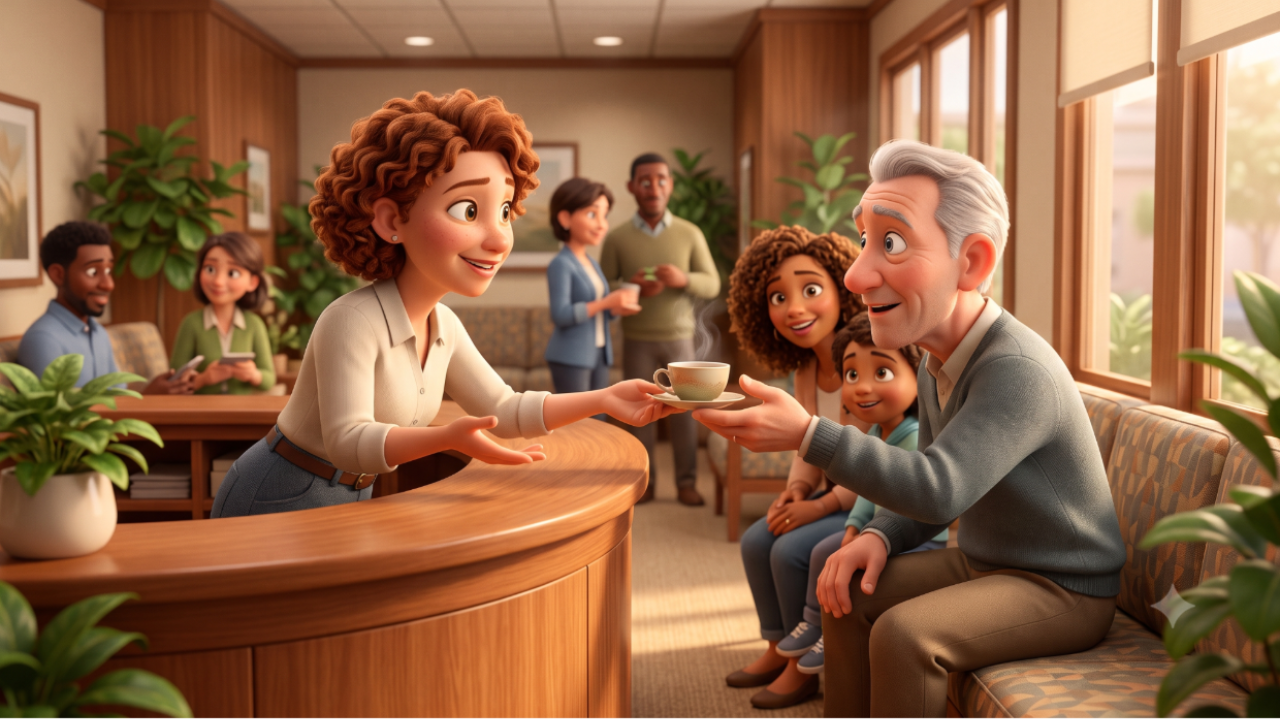
The business application is obvious but often ignored: check in with waiting customers. A brief acknowledgment that they exist. A status update. A cup of tea. These tiny gestures have outsized impact.
As Maya Angelou famously said, "People will forget what you said, people will forget what you did, but people will never forget how you made them feel." That applies to the waiting room as much as the consultation room.
Principle 4: Make Progress Visible
Disney queues are almost never static. You're always moving, even if slowly. The path curves and twists, creating the illusion of progress. You pass through rooms, zones, environments — each transition signalling advancement.
Contrast this with the doctor's surgery queue where you sit in one spot, staring at the same wall, with no indication of whether you're next or whether there are forty people ahead of you.
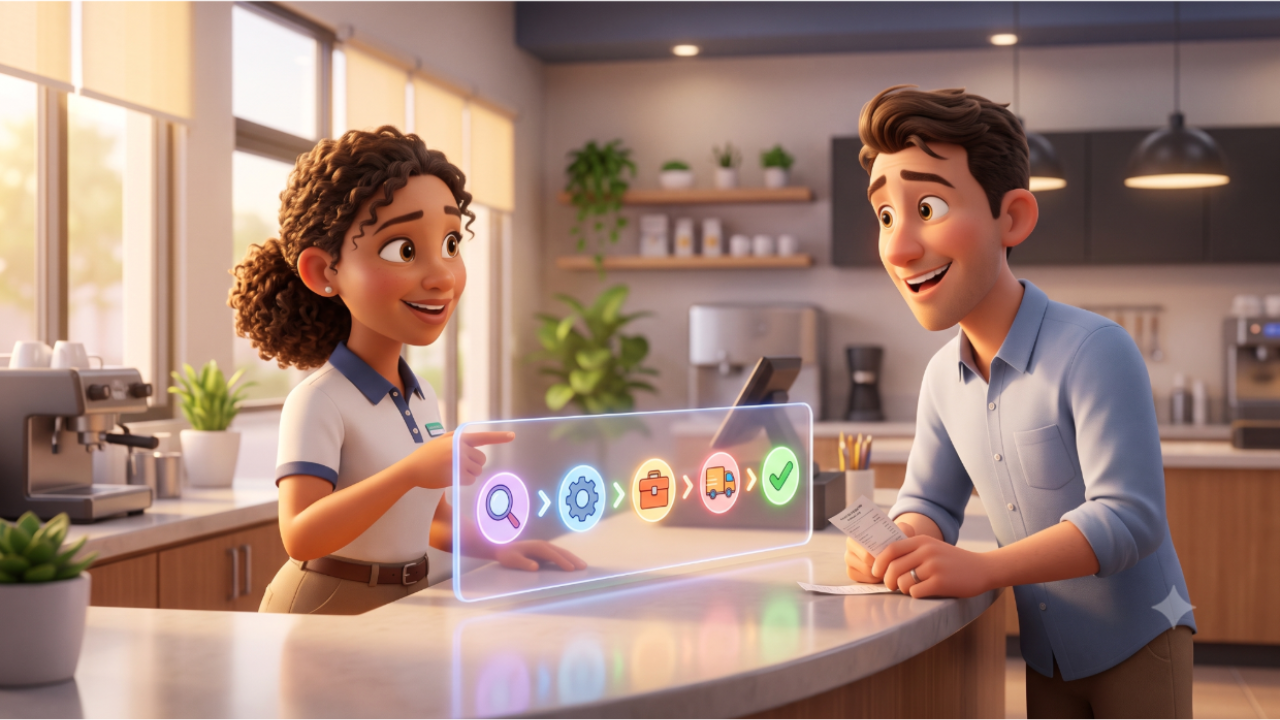
For your business: How can you make progress visible? Order tracking. Email updates. Stage-based communication. ("Your quote is with our senior surveyor for review.") Even a simple acknowledgment that you're moving through a process transforms the psychological experience of waiting.
Principle 5: End Strong
Research by psychologist Daniel Kahneman (the "peak-end rule") shows that we judge experiences largely by their peak moment and their ending. Disney queues are designed to build to a climax — the moment just before you board, when anticipation is highest and the full theming surrounds you.
The worst queues do the opposite. They dump you at the end, disoriented and deflated. "Oh, we're here now? I wasn't ready."
Consider how your "queues" end. Is there a clear transition from waiting to service? A welcome? A handoff? Or do customers just... eventually get served with no ceremony?
Tigger — bouncy, energetic, incapable of containing his enthusiasm — embodies what the end of a queue should feel like. That burst of energy right before the main event. "The wonderful thing about Tiggers is Tiggers are wonderful things!"
Quiz time!
A client calls your business and is put on hold for 5 minutes. What do they hear?
A) Silence, leading them to believe the call has dropped, followed by them hanging up and writing an angry email
B) A 30-second loop of tinny music so repetitive it could be used as psychological torture
C) Engaging hold content — perhaps useful information about your services, estimated wait time updates, and assurance that their call is important (and actually meaning it)
If you answered A or B... well, at least you're providing an authentic customer experience. Of something. I'm not sure what, but it's definitely authentic.
Disney vs. The Rest of the World: A Tale of Two Queues
It's a Tuesday afternoon, and you're standing in the queue at your local council office.
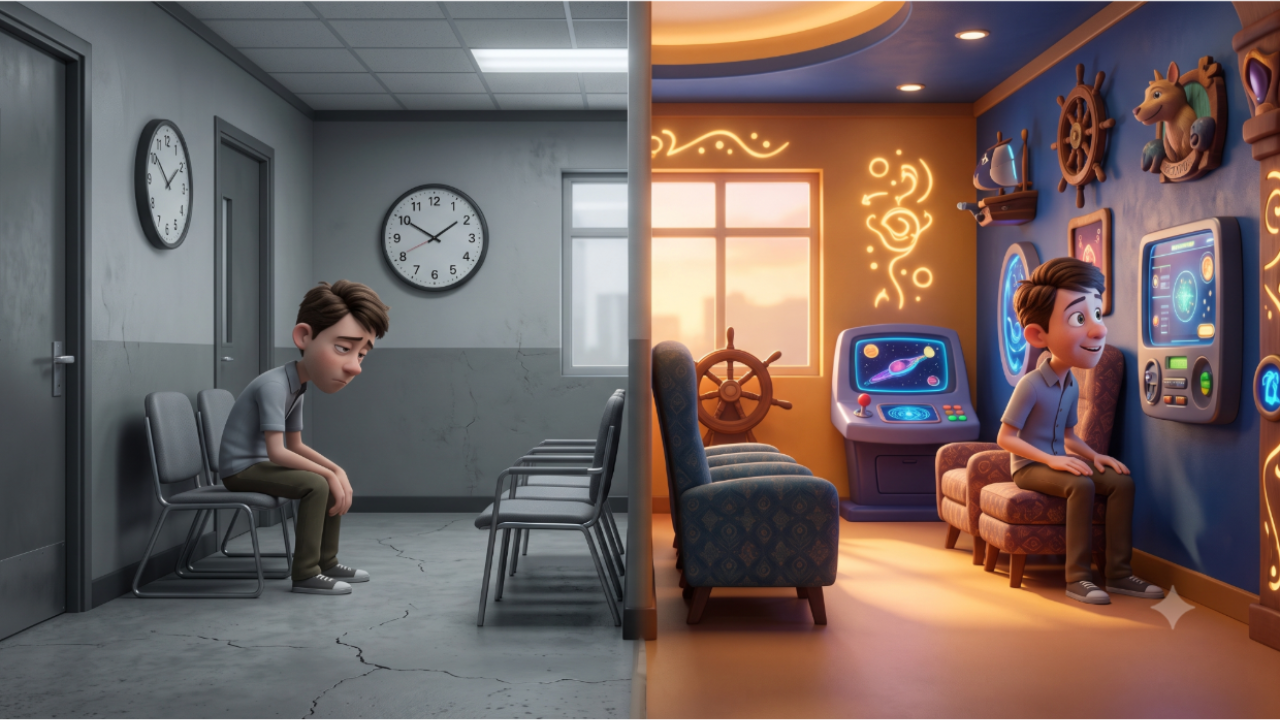
The room is lit by fluorescent tubes that hum slightly. There's a ticket dispenser by the door. Your number is 847. The screen currently shows 791. There are no windows. The chairs are bolted to the floor in a way that suggests the council expects violence. A sign says "PLEASE WAIT TO BE CALLED" in a font that conveys no enthusiasm whatsoever.
You check your phone. You check the screen. You check your phone again. You begin to question your life choices.
Now transport yourself to Guest Relations at Magic Kingdom.
Same basic situation — you need to speak to someone about a problem. But the environment is different. The cast member at the entrance acknowledges you immediately. There's a comfortable waiting area with themed décor. You're told approximately how long the wait will be. Someone offers to help with simple issues right there, reducing the queue for complex problems.
When you're called, the cast member's body language says "I'm delighted you're here" rather than "You are customer #847 and my shift ends in 47 minutes."
Same function. Same queue. Completely different experience.
Most businesses design their customer touchpoints backward. They obsess over the "main event" — the product, the service, the core offering — and treat everything else as infrastructure. A necessary evil.
Disney flips this. They understand that the customer doesn't distinguish between "service" and "waiting for service." It's all one continuous experience. And the waiting often takes longer than the service itself.
Think about it: a restaurant meal might take 45 minutes to eat, but you might wait 20 minutes for a table, 15 minutes for your order to arrive, and 10 minutes for the bill. That's 45 minutes of "queue" for 45 minutes of eating. Yet which part gets the design attention?
Here's where companies like Zappos have figured this out. Their customer service calls have no time limits. Representatives are actively encouraged to chat, build relationships, and solve problems thoroughly. The "queue" of being on a customer service call isn't something to rush through — it's an opportunity to create loyalty. Their longest customer service call on record? Over 10 hours. (I am not making this up.)
Four things you can do this week:
- Audit your hidden queues. Map every point where customers wait: for quotes, callbacks, appointments, deliveries, responses. These are your queues, even if they don't feel like it.
- Add value to at least one queue. Pick your longest or most frustrating wait point. What can you add? Information? Entertainment? Human contact? Clear communication about timelines?
- Communicate proactively. Before customers have to wonder what's happening, tell them. "Your appointment is confirmed for Tuesday at 2pm. Here's what to expect..." Pre-emptive communication eliminates anxiety.
- Train your team to see queues as opportunities. Anyone who interacts with waiting customers should understand that these moments are prime relationship-building time, not dead zones.
Baloo from The Jungle Book had it right: "Look for the bare necessities, the simple bare necessities." The "necessities" of queue management aren't complicated. Clear communication. Human acknowledgment. Something useful to occupy the time. Visible progress. That's it. That's the recipe.
Quiz time!
You run an accounting firm. A potential client has requested a quote for annual services. What happens next?
A) They receive the quote sometime in the next week, with no communication in between, leaving them to wonder if their email was received
B) They receive an auto-reply saying "We'll be in touch" and then hear nothing until the quote arrives, possibly during a period when they've already forgotten they asked
C) They receive an immediate acknowledgment with a clear timeline ("You'll receive your quote within 48 hours"), a follow-up email the next day with useful information about what's included, and the quote delivered slightly ahead of schedule with a personal note
If you answered A or B, you've accidentally created the council office experience. In accounting form.
The Waiting Room Revolution: A Case Study in Transformed Queues
Last year, I worked with a dental practice in Manchester — let's call them Bright Smile Dental — that had a problem.
Their dentistry was excellent. Clinical outcomes were strong. The team was skilled. But patient satisfaction scores were stubbornly average. And patient retention? Worse than average. People would come for treatment, receive good care, and then never come back.
When we dug into the feedback, a pattern emerged. Patients weren't complaining about the dentistry. They were complaining about everything else.
"The waiting room feels clinical and cold."
"I never know how long I'll be waiting."
"It feels like I'm just a number."
"The whole experience is stressful before I even see the dentist."
The practice had invested heavily in equipment, training, and clinical excellence. They'd invested almost nothing in the patient experience around the clinical care.
So we applied Disney's queue principles. Not with a massive budget — this was a small practice, not Walt Disney World. But with intention.
The changes:
First, we redesigned the waiting area. Gone were the harsh overhead lights (replaced with warmer alternatives). Gone were the medical posters about gum disease (replaced with calming artwork). We added a coffee station. We put in comfortable chairs that faced each other in conversation clusters rather than rows facing a wall.
Second, we implemented clear communication. Patients received a text 24 hours before their appointment with what to expect, where to park, and who they'd be seeing. When they arrived, reception confirmed the wait time. If there was a delay, someone came out to explain and offer a cup of tea.
Third, we created useful waiting content. A tablet with information about treatments. A short video about the team. Educational materials that were actually interesting rather than terrifying.
Fourth, we trained the team to check in. If someone had been waiting more than ten minutes, a team member would come out, acknowledge them by name, and give an update. Simple. Human.
The results after six months:
Patient satisfaction scores went from 7.2 to 8.9 out of 10. Patient retention improved by 34%. And here's the interesting part: clinical care hadn't changed at all. Same dentists, same treatments, same outcomes. But the experience around the care had transformed.
The practice owner told me something that's stuck with me: "I spent years trying to be a better dentist. Turns out I needed to be a better host."
Lessons from the Bright Smile transformation:
- The queue often matters more than you think. For this practice, the waiting room experience was shaping overall perception more than the clinical care.
- Small changes compound. No single improvement was dramatic, but together they created a fundamentally different feeling.
- Communication is free. The text messages, the check-ins, the updates — these cost almost nothing but had massive impact.
- People remember how you made them feel. Patients weren't remembering the specific treatment details. They were remembering whether they felt cared for, respected, and welcomed.
What's your version of the waiting room? And what would happen if you treated it as the practice owner eventually did — as a critical part of the experience, not just a holding pen?
Queue Magic Across Industries: Applying Disney Principles Everywhere
Let's take this beyond dental practices and talk about how the queue principle works across different industries. Because I guarantee you've got queues in your business, even if you don't call them that.
Retail
Your queue isn't just the checkout line (though that matters too — IKEA's serpentine queue past impulse-buy items is genius). Your queue is also the time between "I'm interested in this product" and "I've purchased it." For e-commerce, that's the cart abandonment zone. Can you add value during the decision-making queue? Product recommendations? Customer reviews prominently displayed? A helpful chat widget? The goal: make browsing feel like discovery, not delay.
Professional Services
Your queue is the onboarding process. From initial enquiry to first meeting to ongoing service, there are gaps where clients wait. Fill them with value. A solicitor could send educational content about the legal process. An architect could share inspiration images. A consultant could provide a pre-meeting questionnaire that makes the client feel involved. Every touchpoint is an opportunity.
Hospitality
The queue is everywhere: checking in, waiting for a table, the time between ordering and food arriving. Some restaurants have cracked this — amuse-bouche offerings, table-side bread service, visible kitchen action that makes waiting feel like anticipation. Others treat you like you're inconveniencing them by being hungry. The difference in repeat business is predictable.
Trades and Home Services
For a plumber or electrician, the queue is the appointment window. "We'll be there between 9am and 5pm" is the queue from hell. But "Your technician John will arrive between 10:15 and 10:45 — here's his photo, his qualifications, and what to expect" transforms the experience. The actual service might be identical, but the perceived quality is completely different.
Health and Wellness
Medical waiting rooms are notorious for being stress-inducing environments. But some forward-thinking practices are changing this. Comfortable environments. Clear communication about delays. Calming elements. Educational content that's actually helpful rather than anxiety-producing. The goal isn't to eliminate the wait (sometimes that's not possible) but to eliminate the suffering during the wait.
Online and E-commerce
Your queue is the delivery window. Between purchase and arrival, your customer is waiting. What are you doing with that time? Amazon's tracking updates have set an expectation: customers want to know where their order is, every step of the way. But you can go further. Apple sends beautiful emails with product imagery while orders are "being prepared." Subscription boxes tease upcoming contents. The delivery queue becomes part of the anticipation, not just a delay.
As Walt Disney said, "It's kind of fun to do the impossible." And transforming your most frustrating customer touchpoint into a competitive advantage? That might sound impossible until you actually try it.
Quiz time!
You run an online business. A customer places an order on Monday for delivery on Friday. What happens between Monday and Friday?
A) Absolutely nothing — they ordered, they'll receive it when they receive it, what more do they want?
B) A single shipping confirmation email with a tracking number that requires five clicks and a PhD to decipher
C) A confirmation email with clear delivery expectations, a mid-week "your order is on its way" update with visual tracking, and a day-before reminder with delivery window and what to do if they need to reschedule
If you answered A, congratulations — you've invented the "surprise delivery" experience. Unfortunately, the surprise is usually "I forgot I ordered this."
The Long Game: Why Queue Excellence Pays Off Over Time
Here's a statistic that should make you sit up: according to Forrester Research, 66% of customers say that valuing their time is the most important thing a company can do to provide good service.
Not the lowest prices. Not the fanciest product. Not the most features. Respecting their time.
When you transform your queues from dead zones into value zones, you're not just fixing a friction point. You're building something much more valuable: trust.
Consider what excellent queue management signals to customers:
- "We've thought about your experience."
- "Your time matters to us."
- "We care about how you feel, not just what we deliver."
- "We're organised enough to communicate clearly."
- "We see you as a person, not a transaction."
These signals compound. A customer who feels respected during the wait is more forgiving if something goes wrong with the service. A client who receives valuable communication during the onboarding queue arrives at the first meeting already trusting you. A patient who feels comfortable in the waiting room is more receptive to the treatment plan.
Research from Bain & Company — the same firm that gave us the famous "5% retention increase = 25-95% profit increase" statistic — shows that customer experience is the ultimate driver of loyalty. And queue experience is a massive, often ignored, component of overall experience.
Disney World welcomes approximately 58 million visitors annually. The vast majority of them come back. And they don't come back despite the queues — they come back including the queues. Because Disney has turned waiting into part of the attraction.
Think about your own business over a three-year horizon. If you transformed every waiting touchpoint into a positive experience, what would happen to:
- Customer satisfaction scores?
- Word-of-mouth referrals?
- Repeat business rates?
- Staff morale? (Yes, staff who see happy customers are happier staff.)
- Your competitive position?
The queue is where differentiation happens. Because most of your competitors aren't thinking about this. They're obsessing over the product and ignoring the packaging. Meanwhile, you can win by obsessing over everything.
As I discuss in Walt's Way, Disney magic isn't about having deep pockets. It's about having deep caring. The budget for a bioluminescent cave queue is massive. The budget for clear communication, human acknowledgment, and intentional design of waiting experiences? Minimal. The impact? Potentially identical.
Cinderella didn't get to the ball because she had the best resources. She got there because her Fairy Godmother paid attention to the details — the right dress, the right shoes, the right timing. Your queue management is your Fairy Godmother moment. The details matter. 🌟
Quiz time!
You're calculating ROI on customer experience improvements. What should you measure?
A) Just the direct cost savings from faster transactions — time is money, after all
B) Only customer satisfaction scores — feelings matter more than finances
C) A combination of satisfaction scores, retention rates, referral tracking, repeat purchase frequency, and lifetime customer value — because queue improvements affect all of these
If you answered A, you're a pragmatist. If you answered B, you're a romantic. If you answered C, you're thinking like Disney.
The Spoonful of Sugar: Challenges and Reality Checks
Right. I've spent the last several thousand words singing the praises of queue transformation. Now let me be the responsible friend who mentions a few realities.
Disney isn't perfect at this either.
The Lightning Lane system (Disney's paid queue-skipping option) has created tension. Guests who pay extra get shorter waits, which makes the regular queue feel worse by comparison. Some attractions have queues that don't live up to the promise — just functional switchbacks with minimal theming. And when systems fail (the app crashes, posted times are wildly inaccurate), guest frustration is amplified because expectations have been set high.
The lesson: if you're going to promise a good queue experience, you have to deliver consistently. Inconsistency is worse than low expectations.
Challenge 1: Budget constraints
You don't have Disney's resources. That's fine. Remember: the principle is about intention, not investment. Clear communication costs almost nothing. Human acknowledgment costs nothing. A slightly overestimated timeline costs nothing. Start with what you can control immediately, then build from there.
Challenge 2: Staff buy-in
Your team might see "queue management" as extra work. The reframe: it's not extra work, it's the actual work. Customer experience IS the product. Get staff involved in identifying queue pain points and designing solutions. People support what they help create.
Challenge 3: Consistency
One brilliant queue experience followed by three mediocre ones isn't a strategy. It's a recipe for disappointment. Whatever you implement, make it systematic. Train on it. Check on it. Make it part of your standard operating procedure, not a special occasion.
Challenge 4: Knowing your queues
Many businesses don't know where their customers are waiting. You might need to map the entire customer journey to identify the hidden queues — the gaps between touchpoints where customers are waiting for something without you realising it.
Challenge 5: Measuring impact
Improved queue experience doesn't show up neatly on a spreadsheet. You'll need to look at lagging indicators — retention, satisfaction, referrals — and correlate them with your changes. It's not instant gratification. It's investment.
Mary Poppins, as always, had wisdom for the situation: "In every job that must be done, there is an element of fun. You find the fun and — SNAP! — the job's a game." Transforming your queues is work. But approached with the right mindset, it's also an opportunity to differentiate, delight, and build something your competitors won't bother to match.
Final quiz!
You've read this entire article about queue management. What do you do next?
A) Think "that's interesting" and then change absolutely nothing
B) Plan an elaborate queue-theming project that will take eighteen months and never actually launch
C) Identify ONE queue in your business this week, make ONE improvement to it, and measure the customer response
If you answered A, thank you for reading, and I hope you at least enjoyed the Disney references. If you answered B, I admire your ambition but worry about your execution. If you answered C, you've understood the Disney way: start small, do it well, and keep improving.
Frequently Asked Questions
Q: What if we genuinely can't reduce wait times? Does this still apply?
Absolutely — in fact, it might apply even more. Disney's most spectacular queue theming is on their attractions with the longest waits. Flight of Passage, with its 90-minute average queue, has one of the most elaborate pre-show experiences. The principle isn't about eliminating waits (sometimes you can't). It's about transforming what happens during them. A 45-minute wait that feels valuable is better than a 20-minute wait that feels wasted. Focus on the experience, not just the clock.
Q: Won't customers think we're trying to distract them from poor service if we invest in "queue entertainment"?
Only if your service is actually poor. Queue improvement isn't a cover-up strategy — it's part of a comprehensive experience. If you have service problems, fix those too. But don't wait until everything else is perfect to improve the queue. Customers can appreciate multiple good things at once. Think of it like a restaurant: good food doesn't excuse terrible service, but good food AND good service together create loyalty. Improve everywhere, not sequentially.
Q: How do I get my team to care about this when they have "real work" to do?
Reframe what "real work" means. The customer experience IS the product, especially in service businesses. A team member who creates a wonderful waiting experience is doing just as much real work as someone delivering the core service. Start by involving the team in identifying pain points — they often know exactly where customers suffer. Let them own solutions. And celebrate when queue improvements show results. When staff see the connection between their "extra" effort and customer satisfaction (and their own easier work days when customers arrive happy), buy-in follows.
Q: This seems expensive. What if I can't afford to redesign waiting areas or build apps?
Disney's billion-dollar queue theming is impressive but not necessary. The core principles — clear communication, human acknowledgment, occupied time, visible progress, managing expectations — are nearly free to implement. Send a confirmation text. Post realistic wait times. Train staff to check in with waiting customers. Create useful content for your website. Under-promise and over-deliver on timelines. None of this requires a theme park budget. Start with intention, not investment.
Q: What about digital businesses? We don't have physical queues.
Every business has queues — they just look different online. The time between adding to cart and completing purchase. The delivery wait. The gap between enquiry and response. The onboarding process for new users. These are all queues. Apply the same principles: communicate clearly about what's happening and when, provide value during the wait (content, updates, engagement), make progress visible (order tracking, status updates), and end the queue experience on a high note (delivery confirmation, welcome sequences, post-purchase follow-up).
Q: How do I know if my queue improvements are working?
Three measurement approaches: First, direct feedback — ask customers about their experience, specifically mentioning waiting or the touchpoints you've improved. Second, proxy metrics — track changes in satisfaction scores, retention rates, referral numbers, and repeat purchases over time. Third, operational indicators — complaint volume, staff stress levels, time spent handling queue-related frustrations. Change takes time to show in lagging indicators, so measure consistently over months, not days. And don't underestimate qualitative feedback: when customers start voluntarily mentioning how smooth the experience was, you're winning.
Putting It All Together: Your Magical Queue Transformation
We've almost come to the end of our magical journey through the land of queues, waiting, and the strange alchemy of turning dead time into valuable time.
Let me leave you with the core principles one more time — not as a list, but as a story.
Your customers don't separate "waiting" from "service." To them, it's all one experience. The moment they make contact with your business, the clock starts — and every moment after that shapes their perception of who you are and whether you're worth their loyalty.
Disney figured this out decades ago. They realised that if guests spend more time in queues than on rides, the queues had better be good. So they invested — not just money, but thought — into making every moment count. The result? Guests happily wait 90 minutes for a 4-minute ride and describe the entire experience as magical.
You can do the same thing in your business. Not with bioluminescent caves and floating avatars (unless your budget is significantly larger than most). But with intention. With communication. With human acknowledgment. With useful content. With clear expectations, honestly set and consistently beaten.
The challenge I want to leave you with is this: How can you make your customer's waiting experience not just tolerable, but genuinely valuable?
Because that's where the magic happens. Not in the ride. In the queue.
Disney magic isn't about having a castle or a talking mouse. It's about creating moments of wonder in the everyday — including, maybe especially, in the moments that everyone else ignores.
As Walt Disney reminded us, "Do what you do so well that they will want to see it again and bring their friends."
That includes the waiting. Especially the waiting.
Now go transform some queues, you magnificent customer experience wizard. 🎩✨
About the Author
Andrew Lock is a renowned business coach, consultant, and author with over three decades of experience helping entrepreneurs and business leaders achieve extraordinary success. As the founder of Help My Business!, Andrew has empowered thousands of business owners worldwide through his unique coaching, mastermind groups, 10 best-selling books, and engaging keynote presentations.
Known as the "The Yoda of marketing," (without the green pointy ears), Andrew brings a refreshing blend of humor and practical insights to his work. His expertise spans customer experience, pricing, sales, marketing, employee management, and operations, with a special focus on applying Walt Disney's business principles to modern enterprises.
Andrew is the author of ten books, including the popular "Walt's Way" and "Big Lessons from Big Brands." His work has been featured in major media outlets, and he's shared stages with business luminaries like Sir Richard Branson, Donald Trump, Daymond John, Dan Kennedy, The Dalai Lama, and Michael Gerber.
When he's not helping businesses transform their customer service, Andrew enjoys traveling with his family and indulging in his passion for all things Disney and chocolate (though not necessarily in that order).
For more insights and resources, visit www.AndrewLock.com.
Sources & Further Reading
Want to go deeper? Here are a few of the books and resources I referenced (or shamelessly stole ideas from) while writing this:
- Be Our Guest — Disney Institute (the closest thing to a Disney customer service bible — includes detailed coverage of their "Everything Speaks" philosophy)
- Creating Magic — Lee Cockerell (the bloke who ran Walt Disney World operations for a decade knows a thing or two about making every moment count)
- The Psychology of Waiting Lines — David Maister (the Harvard Business School paper that explains why occupied time feels shorter — foundational reading)
- Walt's Way — Andrew Lock (yes, that's my book — but it genuinely covers Disney's customer experience principles in depth, including queue management)
- The Disney Institute Blog: disneyinstitute.com (ongoing insights from Disney's professional development arm)
