Why "That's Not My Department" Is Killing Your Business — And How Disney Trains It Out of Existence
Right, let me tell you about the four most expensive words in business.
They're not "You're fired, pack up." They're not "The taxman called again." They're not even "We're out of biscuits." (Though that last one is a close second.)
No, the four most expensive words in business are: "That's not my department."
Every time someone on your team utters this phrase — or its evil cousins like "You'll have to call back," "I can't help with that," or the dreaded shrug-and-point-vaguely-somewhere-else — a little piece of your customer's goodwill dies. And possibly their soul. Definitely their patience.
Walt Disney understood this nearly seventy years ago. As he once said: "You can design and create, and build the most wonderful place in the world. But it takes people to make the dream a reality."
Notice he didn't say "it takes departments to make the dream a reality." He said people. All of them. Together. Not shuffling customers around like a hot potato at a particularly bureaucratic barbecue.
In this article, I'm going to show you exactly how Disney builds teams where departmental silos go to die — and how you can do the same in your business, whether you're running a small café in Croydon or a mid-sized manufacturing company in Manchester. No castle required. No talking mice necessary. Just a fundamentally different approach to how your people see their jobs.
Let's get on with it, shall we? 🪄
Key Takeaways From This Article:
- Disney's "cross-training" philosophy means every Cast Member is responsible for the entire guest experience — not just their assigned silo. Guests don't see departments; they see one company.
- The phrase "that's not my department" doesn't exist at Disney because it's trained out of people before they ever start their actual job through a programme called Traditions.
- Cross-training isn't about making everyone do everyone's job — it's about ensuring everyone understands enough to help, guide, or at minimum connect the customer to someone who can.
- Disney's Four Keys (Safety, Courtesy, Show, Efficiency) apply to ALL Cast Members, regardless of role. This shared foundation creates consistency across every interaction.
- The "15-foot rule" means any Cast Member engages with any guest within that distance — whether or not the guest's need falls within their department.
- Van France created Disney University in 1955 specifically to ensure this shared knowledge and service approach across all roles. It's been running for nearly 70 years.
- Empowerment requires cross-training — Disney Cast Members can resolve issues on the spot because they understand the broader context, not just their narrow job description.
- Departmental silos create customer friction, and every handoff increases the risk of dissatisfaction. Cross-training eliminates handoffs wherever possible.
- Small businesses can apply this principle immediately by creating a foundational training that covers what EVERYONE needs to know — regardless of their specific role.
- The business payoff is measurable: higher customer retention, better employee engagement, and fewer complaints falling through departmental cracks.
The Day a Street Sweeper Saved Our Anniversary
It was October 2019, and my wife and I were at Magic Kingdom celebrating our wedding anniversary. (We'd specifically chosen Disney because there's no better place to remind your spouse that you're actually quite romantic — even if you've forgotten the chocolates and accidentally booked the wrong restaurant.)
And speaking of the restaurant: I'd made a right mess of things.
I'd somehow managed to book Cinderella's Royal Table for the wrong night. We were standing outside the castle, me clutching my phone with increasing panic, my wife giving me That Look — the one that says "I love you but also how are you this incompetent."
The reservation was for tomorrow. We were dressed up. We were hungry. We were standing there like two lost tourists who'd just realised their tickets were for the wrong theme park.
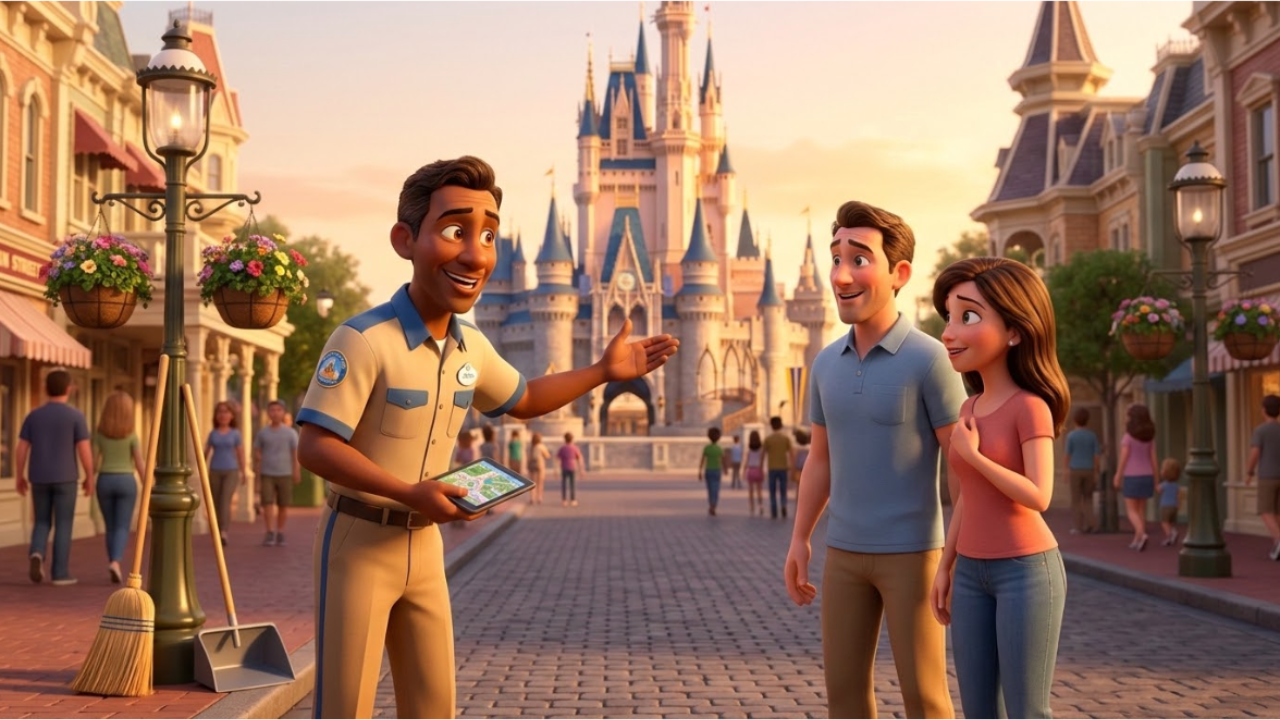
A custodian — yes, a custodian — noticed us looking distressed. He'd been sweeping nearby, probably hoping to enjoy a quiet shift without intervening in yet another tourist crisis. But no such luck for him.
"Everything okay?" he asked, leaning his broom against the wall.
I explained our predicament, fully expecting him to say something like "Guest Relations is that way" before resuming his sweeping. Instead, he pulled out what looked like a small tablet, tapped at it for about thirty seconds, and then looked up with a grin.
"Right, I can see the situation. I can't modify your reservation myself, but I can get someone from Dining who can. They'll meet you at the guest services window just inside the castle entrance in about five minutes. Ask for Jennifer. Also — happy anniversary. The rose garden near the carousel is lovely for photos if you have time."
Five minutes later, Jennifer had shuffled some things around, found us a table for that evening, and apologised for "any inconvenience" — even though the inconvenience was entirely my fault.
Here's what didn't happen: the custodian didn't say "I just clean things, mate." He didn't point vaguely toward a building. He didn't shrug and wish us luck.
He took ownership of our problem as if we'd walked into his living room and asked for help. The problem wasn't his department. But we were his guests.
My wife still brings this up when I claim I'm good at planning.
So let me ask you this: When was the last time someone on your team took ownership of a customer problem that wasn't technically "their job"? And more importantly — would they even know how to?
Core Principle #1: Disney's Secret Weapon — Traditions Training
You're strolling through EPCOT's World Showcase on a Tuesday afternoon. It's pleasantly uncrowded. You stop a Cast Member working at a merchandise cart near the France pavilion to ask about the best place to watch the evening fireworks.
Now, this Cast Member's job is selling Mickey ears and French-themed souvenirs. Fireworks logistics? Not remotely their department. They could reasonably say "I'm not sure, try Guest Relations" and get back to folding t-shirts.
But that's not what happens.
Instead, they tell you about three viewing spots, explain the advantages of each, mention that the Japan pavilion has good sight lines and shorter queues for food, and suggest arriving thirty minutes early if you want to grab a bench near the American Adventure.
How does a merchandise Cast Member know this much about fireworks viewing? Because of something called Traditions.
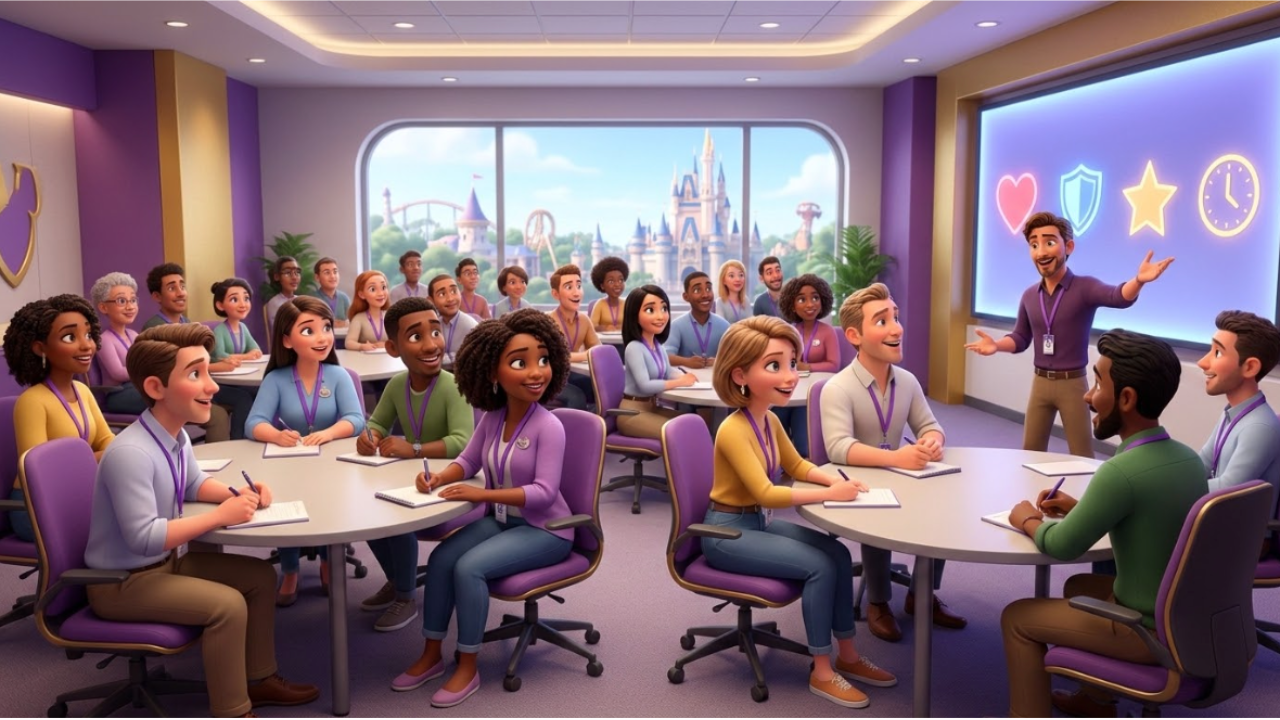
Traditions is Disney's orientation programme, and it's been running since 1955 when a chap named Van France created Disney University. Here's the radical part: every single Disney Cast Member completes Traditions before they ever work a shift. The executive vice president? Traditions. The seasonal ice cream scooper? Traditions. The accountant in the corporate office? Traditions.
It's typically a one-to-two-day immersive experience that covers:
Disney history and Walt's original vision. The Four Keys (their Quality Standards): Safety, Courtesy, Show, Efficiency — in that exact order of priority. Guest service fundamentals that apply to ALL roles. Park layout and navigation basics. The difference between "onstage" and "backstage" behaviour.
Notice what's not on this list: "How to do your specific job." That comes later, in role-specific training. Traditions is about creating a shared foundation that every Cast Member builds upon.
The Disney Institute — which has trained thousands of executives from outside companies on these methods — calls this creating a "service DNA." It's not enough for your customer service team to be good at service. Everyone needs to share the same foundational understanding of what great service means and why it matters.
Lee Cockerell, who ran Walt Disney World operations for a decade, puts it brilliantly in his book Creating Magic: "Everyone needs to know not just their job, but how their job connects to every other job in the organisation. Silos are where great customer service goes to die."
Silos. Where. Great. Customer. Service. Goes. To. Die.
I'd put that on a poster, but it's a bit grim for the break room, isn't it?
Quick Quiz:
Your new receptionist asks why she needs to learn about your warehouse operations when she'll never work there. What do you say?
A) "Good point. Just focus on answering phones and ignore everything else that happens here."
B) "Because I said so, and I'm in charge, and this is my building." (Then glare menacingly.)
C) "Because when a customer calls asking where their order is, you'll be able to help them instead of transferring them to three different people — which is why Disney teaches park geography to everyone, including the people who scoop ice cream."
If you chose A or B, you may want to reconsider your approach to team development. And possibly your management style in general. 🤔
Core Principle #2: The Five Components of Cross-Training That Actually Works
There I was, waiting in line at Jungle Cruise last summer, watching something unfold that would've been invisible to most guests.
A family ahead of us had a child in a wheelchair, and they were trying to work out the logistics of the ride vehicle. The ride operator — whose job is loading boats and cracking jokes about the "backside of water" — smoothly transitioned into what was clearly rehearsed accessibility guidance. She knew the transfer procedures, she knew where the accessible boat would dock, she even knew that the family could get a Return Time for a nearby attraction if the wait ended up being too much.
This isn't a superhuman employee. This is systemic cross-training done right.
Let me break down the five components that make Disney's approach work — and that can work for your business too:
1. Foundational Knowledge Everyone Shares
This is the Traditions layer. It's not about making everyone an expert in everything. It's about ensuring everyone knows the same essential information: your company's values, your basic offerings, your most common customer questions, and how to navigate someone to the right solution.
Think of it like this: every Cast Member knows where the toilets are. Every Cast Member knows where First Aid is. Every Cast Member can give directions to the most popular attractions. This baseline exists regardless of whether they're serving churros or performing as Belle.
2. Problem-Solving Frameworks (Not Scripts)
Disney doesn't hand Cast Members scripts for every situation — that would be impossible. Instead, they teach frameworks. One famous example is the service recovery approach: Listen, Empathise, Apologise, Resolve, Thank (or similar variations). This framework can be applied by anyone to almost any situation, because the principles are universal.
The Cast Member with the wheelchair family didn't have a script. She had a framework for handling accessibility questions that she'd been trained to apply to various situations.
3. Permission to Act
Here's where most businesses fail spectacularly. You can train someone in everything, but if they don't feel empowered to act on that knowledge, they'll still say "let me get my manager."
Disney Cast Members are explicitly empowered to solve problems on the spot within reasonable bounds. The Ritz-Carlton takes this even further — their employees can spend up to $2,000 to resolve a guest issue without managerial approval. Two thousand dollars. Per guest. Per incident. This sounds insane until you realise the alternative is guests leaving unhappy and never returning.
As Maya Angelou once said: "People will forget what you said, people will forget what you did, but people will never forget how you made them feel."
The feeling of "this person can actually help me" versus "this person needs to ask permission" is night and day.
4. Cross-Departmental Exposure
Many Disney roles involve rotation through multiple positions. A front desk Cast Member at a Disney resort might work bell services, concierge, recreation, and food service at different times. This isn't just covering shifts — it's intentional cross-pollination that builds comprehensive understanding.
Zappos famously requires all new hires, including executives, to spend time in customer service. Their CEO Tony Hsieh argued this built empathy and eliminated the "us vs. them" mentality between departments. When the VP of Marketing has personally handled an irate customer call, they think differently about policies that might create irate customers.
5. The "I Don't Know, But..." Response
Disney explicitly trains that "I don't know" is never the end of a conversation. It's the beginning of a problem-solving mission.
The acceptable responses are:
"I don't know, but let me find out for you."
"I don't know, but let me take you to someone who does."
"I don't know, but let me get you the answer before you leave today."
This sounds obvious. And yet — how many times have you been on the receiving end of "I don't know" followed by... nothing? Just a shrug and a dead end?
Now, you might be thinking: "But Andrew, my business isn't a magical kingdom! We sell accounting software/fix boilers/run a dental practice."
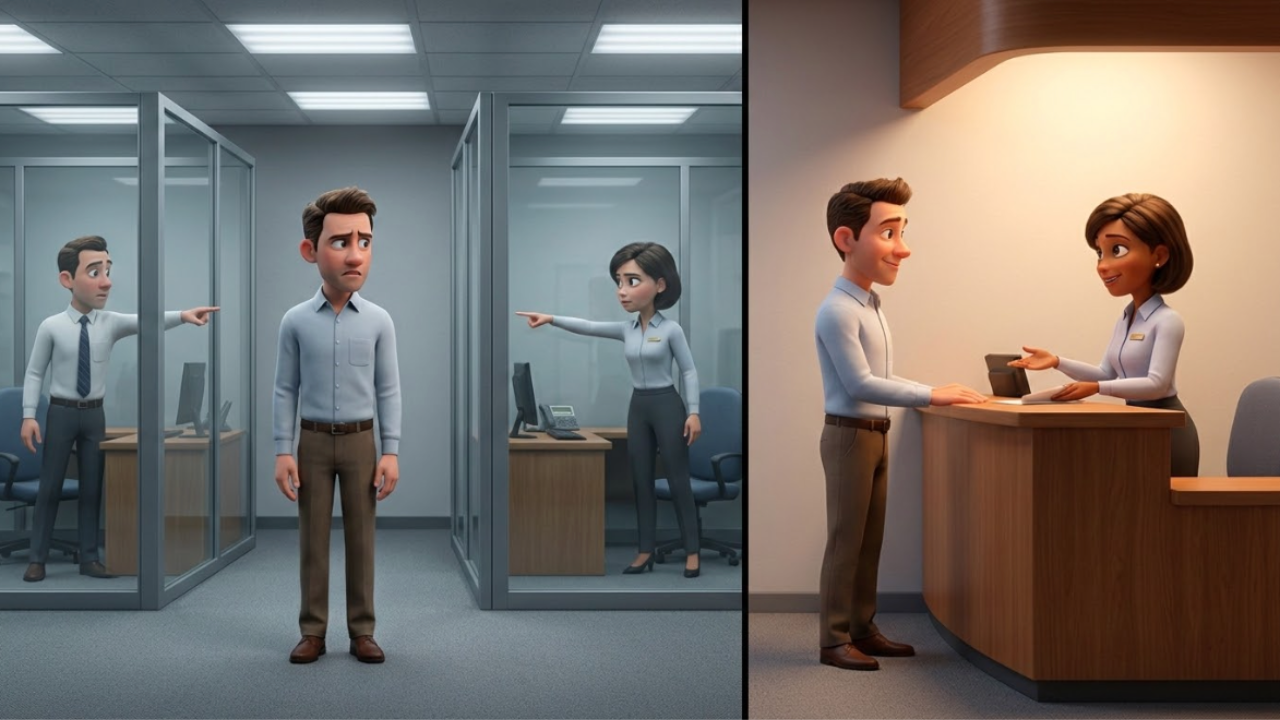
Fair point. But here's the thing: your customers don't know or care about your org chart. They just called your business and have a problem. Whether they reached accounting or sales or customer service, they expected THE COMPANY to help them. Your internal structure is invisible to them — and frankly, it should stay that way.
Quick Quiz:
A customer calls your business and reaches the wrong department. How should your team member respond?
A) "That's not my department. You'll have to call back on a different number." (Provide the number reluctantly if pressed.)
B) "I don't handle that. Let me transfer you." (Then transfer them to a voicemail that's never checked.)
C) "That's actually handled by our service team, but let me see what I can do for you first. What's the situation?" (Then either help directly or warm-transfer them with context.)
If you chose A or B, your customers are definitely complaining about you. They're just doing it to other potential customers, not to you directly. Which is worse. 🌟
Core Principle #3: Disney's Approach vs. How Most Businesses Handle This (Spoiler: Badly)
It's a Saturday afternoon, and you've walked into a department store looking for a gift. You find a nice scarf in the women's accessories section, but you need to know if they have it in blue instead of red.
The Traditional Business Response:
Sales associate: "That's stock information. You'll have to ask someone at the service desk." You walk to the service desk. Queue for ten minutes. Explain the situation. Service desk person: "I can't see specific stock. Let me call accessories." They call. No one answers. "They must be busy. Can you go back and ask them?" You consider setting fire to the building. You do not purchase the scarf. Or anything else. Ever again.
The Disney-Trained Response:
Sales associate: "Great choice! Let me check if we have it in blue." (Pulls out tablet or calls someone while you wait.) "We do have it in blue — it's in the stockroom. I can have someone bring it out in about five minutes, or if you're browsing, I'll find you when it arrives. What would work better for you?"
The difference isn't magic. It's not pixie dust. It's not even complicated.
The difference is that the Disney-trained employee sees the entire transaction — from question to resolution — as their responsibility, even when parts of it involve other people or systems. The traditional employee sees their responsibility ending at the edge of their job description.
The Gallup organisation has researched this extensively. Employees who understand how their work connects to the organisation's broader mission are 3.5 times more likely to be engaged at work. Engaged employees take ownership. Disengaged employees pass the buck.
Disney calls their approach to understanding customers "Guestology" — literally the study of guest behaviour, needs, and expectations. One of its core insights is that guests experience your business as one thing, not as multiple departments. The moment you create a seam between departments that the customer can feel, you've broken the spell.
Think about Buzz Lightyear for a moment. (Bear with me.) In Toy Story, Buzz initially doesn't know he's a toy. He thinks he's an actual Space Ranger. When he discovers the truth, his entire identity shatters.
Your customers are like Buzz before the crisis. They believe your company is one unified entity. Every time they hit a departmental wall, every time they get transferred, every time someone says "that's not my area" — it's like showing them the "Made in Taiwan" sticker on Buzz's arm. The illusion breaks. And unlike Buzz, they don't eventually come around. They just leave.
Here are four action steps you can implement this week:
1. Map the Customer Journey Across Departments
Take one common customer scenario and trace it through every department it touches. Identify every handoff point. Those are your danger zones — places where "not my department" is most likely to happen.
2. Create a "What Everyone Needs to Know" Document
List the twenty most common questions your customers ask. Now make sure EVERY employee — regardless of department — knows the answers. This is your Traditions equivalent.
3. Institute the "No Dead Ends" Rule
No employee is allowed to end an interaction without either resolving the issue or personally connecting the customer to someone who can. No vague pointing. No "call this number." No voicemail handoffs. Warm transfers only.
4. Cross-Shadow for a Day
Have employees spend a half-day shadowing a different department. Not doing the work — just observing. The goal isn't expertise; it's awareness. When your receptionist understands what happens in the warehouse, they make smarter decisions about what to tell customers.
You don't need a castle. You don't need mouse ears. You just need to stop building walls between the people who are all supposed to be serving the same customer.
Quick Quiz:
A customer complaint has arrived that involves three different departments. How do you handle it?
A) Send it to each department separately and let them each send their own response to the customer. (More responses = better service, right?)
B) Assign it to the department that seems most relevant and let them sort it out. Not your problem anymore!
C) Assign one owner who coordinates with all three departments and sends the customer ONE unified response, because the customer doesn't care about your org chart.
If you chose A, congratulations — your customer will receive three confusing emails and never know what actually happened. If you chose B, the complaint will probably die in an inbox while departments argue about whose responsibility it really is.
Real-Life Case Study: The Dental Practice That Stopped Saying "Let Me Check"
I worked with a dental practice in Birmingham about two years ago that had a familiar problem: patients kept calling with questions that "had to go to someone else."
Patient calls: "What time is my appointment next week?"
Receptionist: "Let me check with scheduling and call you back."
Patient calls: "Is the treatment I need covered by my insurance?"
Receptionist: "That's really a question for our billing department. Let me transfer you."
Patient calls: "How long will I need to take off work after the procedure?"
Receptionist: "The dentist would need to answer that. Can you hold?"
Every call ended in a transfer, a hold, or a callback. The receptionists weren't incompetent — they genuinely didn't know the answers. They'd been hired to "answer phones and book appointments," and that's exactly what they'd been trained to do. Nothing more.
The practice owner — a lovely woman named Dr. Patel — told me her patient satisfaction scores were fine but not great. Her team seemed stressed. And she couldn't understand why, because she'd hired good people.
She had hired good people. She just hadn't given them the tools to actually help.
We implemented what I call a "First-Contact Resolution" initiative, modelled directly on Disney's Traditions approach. Here's what we did:
Step One: The Knowledge Audit
We listed the fifty most common questions patients asked. Then we discovered that the receptionists could confidently answer only eleven of them. Eleven out of fifty. The rest required checking, transferring, or calling back.
Step Two: The Foundational Training
We created a two-hour training session covering all fifty questions. Not to make the receptionists into dentists — but to give them enough knowledge to handle routine enquiries without needing backup. "How long will the procedure take?" doesn't require a dental degree. It requires a cheat sheet and some basic training.
Step Three: The Permission Shift
We explicitly told the team: "You are empowered to answer questions without asking permission. If you're unsure, you can say 'Let me confirm that for you' — but the default is that you handle it." This was psychologically massive. The receptionists had never been told they were allowed to answer questions beyond their narrow job description.
Step Four: Cross-Departmental Lunch
Once a month, the whole practice has lunch together, and someone from each area explains what they're working on. The hygienist talks about new techniques. Billing explains insurance changes. The receptionist shares common patient questions. It takes forty-five minutes and costs the price of sandwiches.
The Results After Six Months:
First-contact resolution rate went from 22% to 68%. Meaning more than two-thirds of patient calls were now fully resolved by the first person who answered. Patient satisfaction scores increased by 34%. Staff stress (self-reported) decreased significantly — because playing telephone tag is exhausting for everyone. And here's the kicker: they didn't hire anyone new. Same team. Same payroll. Different training and expectations.
Dr. Patel told me recently that one of her receptionists now confidently explains post-procedure care to patients, freeing up the dental assistants for other work. "She used to transfer those calls," Dr. Patel said. "Now she handles them herself. She's become one of the most valuable people in the practice."
The lessons here are simple:
1. Your team's limitations are often training gaps, not capability gaps. Don't hire your way out of problems you can train your way out of.
2. Permission is as important as knowledge. People won't use what they know if they don't feel empowered to use it.
3. Cross-departmental awareness doesn't require formal programmes. A monthly lunch costs almost nothing and pays for itself in reduced friction.
4. First-contact resolution is measurable. Track it. Improve it. Celebrate it.
How This Principle Works Across Different Industries
Now, I can hear the objection forming: "That's all well and good for dental practices and theme parks, Andrew, but my industry is different."
Is it, though?
Let me walk you through how the "no departmental silos" principle applies across six completely different businesses. Because if a street sweeper at Disney can help rebook a dinner reservation, someone in your business can probably do more than they currently think they can.
Retail Shop
Train floor staff on return policies, delivery timeframes, and loyalty programmes — not just how to work the till. When a customer asks "Can I return this next week?", the answer shouldn't be "Let me find a manager." It should be "Yes, within 30 days with receipt. Would you like a gift receipt now just in case?"
Plumbing/Trades Business
Your plumbers can't do electrical work (and shouldn't). But they CAN be trained to recognise electrical issues, explain them simply to the homeowner, and book the electrician appointment before they leave the house. Cross-selling becomes seamless, and the customer gets one-stop service.
Online Business
Train your customer service team on the basics of product development, shipping logistics, and billing systems. When someone asks "Why is this product out of stock?", the answer shouldn't be "I don't have visibility into inventory." It should be "We're expecting it back in stock around the 15th — would you like me to notify you?"
Restaurant/Café
Servers should know kitchen timing, reservation systems, and allergy procedures. Hosts should know the menu highlights. Everyone should know how to handle a complaint without calling the manager for every raised eyebrow.
Professional Services (Solicitors, Accountants, Consultants)
Your admin staff are often the first point of contact. Train them to answer basic procedural questions, explain timelines, and set expectations — not just to be telephonists who transfer calls to people who are perpetually "in a meeting."
Healthcare/Wellness
Front desk staff should understand enough about treatments to answer basic questions, schedule appropriately, and not need to pull clinicians out of appointments for queries that a thirty-minute training session could resolve.
Walt Disney himself said: "It's kind of fun to do the impossible."
Breaking down departmental silos feels impossible when you're inside a siloed organisation. But it's not impossible. It's just unfamiliar. And unfamiliar is fixable.
Quick Quiz:
Your tradesperson is at a customer's house and notices a problem outside their expertise. What should they do?
A) Pretend they didn't see it. Not their job. Plausible deniability.
B) Say "That looks like a problem. You should call someone about that." Then leave.
C) Say "That looks like it needs attention — it's outside my expertise, but we have a [specialist] on the team. Would you like me to book them before I leave so you don't have to chase it?"
If you chose C, you've just created a cross-sell opportunity, increased customer loyalty, and saved your customer time. If you chose A, enjoy your future Trustpilot reviews. 🎩✨
The Long-Term Benefits: Why This Investment Pays Off for Years
So let's talk about why this matters beyond just "it feels good" and "customers like it." Because I know you're running a business, not a charity, and warm fuzzy feelings don't pay the bills.
There's a famous study from Bain & Company — the one that every customer service consultant loves to quote — showing that holding onto just 5% more of your customers can boost profits by anywhere from 25% to 95%. That's not a typo. It's not a fantasy number. It's the compound effect of retention on lifetime value.
Disney doesn't need to read that study. They've been living it since 1955.
Walt Disney World welcomes approximately 58 million visitors annually. Most of them come back. Some of them come back dozens of times. (My wife and I have visited more than 150 times between the various parks, so we're contributing generously to this statistic.) This repeat visitation isn't an accident. It's engineered — through thousands of small interactions where someone could have said "that's not my department" but didn't.
Here's what the elimination of departmental silos does over time:
Customer Loyalty Compounds
Every seamless interaction builds trust. Every dead-end interaction erodes it. Over years, this compounds dramatically. The business that always helps — even when it's "not their department" — becomes the default choice, the one customers return to without even considering alternatives.

Word-of-Mouth Multiplies
People don't tell their friends "The service was adequate and I was only transferred twice." They tell their friends "I couldn't believe it — the receptionist just handled everything." Remarkable service gets talked about. Departmental run-arounds get complained about.
Team Morale Improves
Employees who feel empowered and knowledgeable are happier. Employees stuck in tiny silos, constantly saying "that's not my area," are frustrated. Cross-training increases engagement because it increases meaning. People can see how they fit into the bigger picture.
Operational Resilience Grows
When your team is cross-trained, you can absorb absences, handle surge demand, and adapt to unexpected situations. If only one person can answer billing questions and that person is on holiday, you have a bottleneck. If three people can answer basic billing questions, you have flexibility.
Complaint Costs Drop
Every complaint that bounces between departments costs you. It costs staff time, management attention, and customer patience. First-contact resolution slashes these costs. The Harvard Business Review has reported on the "service recovery paradox" — customers who experience a problem that's resolved well actually become MORE loyal than customers who never had a problem. But the key is "resolved well," not "bounced around until they gave up."
Disney magic isn't about deep pockets. It's about deep caring. And caring means not abandoning someone at the edge of your job description.
Quick Quiz:
You've just spent money cross-training your team. How do you measure whether it was worth it?
A) There's no way to measure soft skills. Just assume it worked and move on.
B) Survey the team and ask if they feel more empowered. (Feelings = data, right?)
C) Track first-contact resolution rates, customer satisfaction scores, complaint volumes, and repeat purchase behaviour over time. Compare before and after. Actual measurement.
If you chose A or B, you're treating training like a lottery ticket — spend the money and hope for the best. Option C is how Disney runs its business, and it's why they can justify spending significant resources on training programmes that don't directly generate revenue.
Challenges & Reality Check: The Spoonful of Sugar
Right, I'm not here to rain on your magical parade, but let's be honest about the challenges. Disney makes this look easy because they've been doing it for nearly seventy years and they have resources you and I can only dream about.
You? You're probably going to hit some bumps.
Challenge 1: Initial Training Time and Cost
Cross-training takes time. Time when people aren't doing their "actual" job. This creates short-term productivity dips and, depending on how you structure it, direct costs. The temptation to skip the training and "just hire people who figure it out" is real.
Reality: Disney spends this time because they know it saves money in the long run. But they also make training ongoing, not a one-time event. Start small. The foundational "what everyone needs to know" training doesn't have to be a two-day residential course. It can be a two-hour session followed by monthly refreshers.
Challenge 2: Employee Resistance
Some employees have built their identity around their silo. "I'm the billing person. Billing is my thing." Asking them to become more generalist can feel like a demotion or a threat to their expertise.
Reality: Position cross-training as adding skills, not replacing them. You're not making the billing expert less of an expert. You're helping everyone else understand billing basics so the expert isn't interrupted constantly with questions they shouldn't need to answer.
Challenge 3: Consistency Is Hard
Even Disney struggles with this. On any given day, with 75,000 Cast Members, someone is having a bad day. Someone is new and still learning. Consistency at scale is genuinely difficult, and the bigger your organisation, the harder it gets.
Reality: Disney handles this through constant reinforcement, measurement, and feedback. Mystery shoppers. Guest surveys. Daily meetings where service standards are discussed. If you want consistency, you have to keep talking about it. Loudly. Repeatedly. Forever.
Challenge 4: "But My Business Is Different!"
I've heard this from accountants, lawyers, factory owners, and even once from someone who ran a camel riding tour business. (Really.) The details of your industry ARE unique. But the principle — that customers experience your business as one entity and shouldn't hit departmental walls — is universal.
Reality: Yes, your compliance requirements are different. Your safety regulations are different. Your service offerings are different. But none of that changes the fact that when someone calls your company, they just want help. Adapt the principle to your context. Don't use context as an excuse to avoid the principle.
Challenge 5: Disney Isn't Perfect Either
Let's be honest: Disney gets this wrong sometimes too. I've been transferred at a Disney resort. I've received conflicting information from different Cast Members. The MagicBand rollout years ago was plagued with technical issues and staff who didn't know how to help. Disney's current app — which handles everything from dining reservations to Lightning Lane — is frequently criticised for being confusing, and Cast Members sometimes struggle to troubleshoot it.
Reality: The goal isn't perfection. The goal is a system designed for success rather than a system that makes silos inevitable. Disney has that system, even when individual moments fall short. Most businesses don't have the system at all — they just have silos and hope.
Five Practical Strategies for Overcoming These Challenges:
1. Start Small and Specific: Pick one customer journey. Map it. Fix the handoff points. Then do another. Don't try to rebuild everything at once.
2. Invest in Your Team Incrementally: You don't need a Disney University budget. Thirty minutes a week of cross-departmental knowledge sharing adds up over time.
3. Be Smart About What "Cross-Training" Means: Not everyone needs to know everything. Define the foundational layer (what everyone must know) versus specialisation (what only some people need).
4. Set Realistic Expectations: This won't transform your business overnight. Give it six months. Measure. Adjust.
5. Keep the Long-Term Benefits in Mind: When training feels expensive or frustrating, remember the Bain research. 5% more retention = 25-95% more profit. You can afford the sandwiches for the cross-departmental lunch.
As Mary Poppins would say, a spoonful of sugar helps the medicine go down. The medicine here is accepting that change is hard. The sugar is knowing it's worth it.
Quick Quiz:
Your staff are resisting the new cross-training initiative. What do you do?
A) Mandate compliance. It's YOUR business. They'll do what they're told.
B) Cancel the initiative. Clearly it wasn't meant to be.
C) Ask what specific concerns they have, involve them in shaping the programme, and show them how cross-training benefits them personally — not just the company.
If you chose A, enjoy your hostile workplace. If you chose B, enjoy your competitors out-servicing you. 🧙♂️
Frequently Asked Questions
Q: We're a tiny business with just five employees. Everyone already does everything. Does this even apply to us?
A: Here's the thing — small businesses often have informal cross-training but lack the intentional version. Yes, your five employees probably help each other out. But do all five of them know the same answers to common customer questions? Could any of them handle your most important call if you were suddenly unavailable? The principle scales down beautifully. In fact, the smaller you are, the more critical it is that everyone shares foundational knowledge, because you don't have the luxury of backup. Think of it less as "cross-training" and more as "eliminating single points of failure." Cinderella had multiple mice helping with the dress for a reason.
Q: What about liability? If someone gives advice outside their expertise and it goes wrong, aren't we exposed?
A: Valid concern, and one that Disney thinks about constantly — after all, they're dealing with safety-critical operations. The key distinction is this: cross-training covers guidance and navigation, not professional recommendations. You're training people to understand enough to help direct customers, not to practise medicine or law. A receptionist at a dental practice can say "Root canals typically require about a day of recovery, but Dr. Patel will give you specific guidance during your consultation." That's not medical advice. That's customer service. Know the line. Train people where it is. And when in doubt, "Let me connect you with someone who can give you the definitive answer" is always available.
Q: How do I get buy-in from employees who've been doing things the old way for years?
A: You show them what's in it for them. Cross-trained employees are more valuable in the job market (career development). They're interrupted less often by basic questions (because more people can handle them now). They feel more competent and less like they're always saying "I don't know." Disney's Traditions programme works partly because it's positioned as an honour — you're being inducted into the Disney way, not just ticking a compliance box. Frame it as capability-building, not corporate mandates. Elsa didn't win people over by commanding ice powers. She won them over by using her powers to help. (Right, I'm stretching the metaphor, but you get the idea.)
Q: We have high turnover. Isn't it a waste to train people who'll leave in six months?
A: This one drives me up the wall, because it assumes turnover is inevitable. But here's what Gallup's research shows: employees who feel connected to the broader mission — who understand how their work matters — are significantly less likely to leave. Cross-training reduces turnover by increasing engagement. You might have high turnover because people feel like disconnected cogs in a machine. Also, even if someone leaves, the six months you had them working effectively is better than six months of them constantly transferring calls and frustrating customers. Train them anyway.
Q: How do we maintain quality when people are doing things outside their main role?
A: This is why foundational training matters so much. Disney doesn't expect a custodian to run a ride. They expect all Cast Members to share the same baseline knowledge and service standards, then specialise from there. Your cross-training should clearly delineate what's in the "everyone should know this" basket versus what requires specialisation. The merchandise Cast Member who helped me with fireworks viewing spots wasn't operating the fireworks — she just knew the viewing logistics. Clear boundaries, clear expectations, and ongoing reinforcement. That's the secret. Not that there really is a secret. Just actual work.
Q: What's a realistic timeline to see results?
A: You'll see behavioural changes within weeks if the training is good and management reinforces it. The dental practice I mentioned earlier saw measurable improvements in first-contact resolution within three months, and significant customer satisfaction increases by six months. The full cultural shift — where "that's not my department" becomes genuinely unthinkable — takes longer. Disney's been at this for seventy years, so don't expect overnight transformation. But momentum builds. Every time someone handles a cross-departmental question successfully, it reinforces the new approach. Every time they're celebrated for it, the culture solidifies. Give it a year before judging fully. That's what I tell all my coaching clients, and it's what I'd tell you too.
Putting It All Together: Your Invitation to Kill the Silos
Right, we've almost come to the end of our journey through the magical land of "actually helping customers properly."
Here's what we've covered:
Disney's genius isn't pixie dust or talking mice. It's the relentless, systematic elimination of the phrase "that's not my department" — starting before Cast Members ever work their first shift. Traditions trains everyone in the same foundational knowledge. The Four Keys give everyone the same service priorities. The 15-foot rule means everyone engages with guests nearby. And the empowerment to act means problems get solved where they appear, not passed around until someone gives up.
Customers don't see your org chart. They see your business. One business. When they hit a wall between departments, the spell breaks. When someone takes ownership and helps them regardless of job description, they remember it forever.
This principle works whether you're running a theme park, a dental practice, a plumbing company, or a three-person consulting firm. The scale differs. The application differs. The fundamental truth — that customers deserve seamless help — is constant.
So here's your challenge:
What would happen if you banned the phrase "that's not my department" starting tomorrow?
Not punitively. Not with threats. But as a genuine invitation: what would you need to change so that no one on your team ever needed to say it?
What training would they need? What permissions would they need? What cross-departmental awareness would make the difference?
Disney magic isn't about having a castle or a talking mouse. It's about creating moments of wonder in the everyday. And the moment when a customer calls, reaches the "wrong" person, and STILL gets their problem fully resolved — that's wonder.
That's magic.
As Walt Disney himself once said: "Do what you do so well that they will want to see it again and bring their friends."
The customers who experience seamless service — who never feel the seams between your departments — are the customers who come back. And bring their friends.
Now go sprinkle some pixie dust on those departmental walls. Or, you know, just tear them down entirely. 🪄
About the Author
Andrew Lock is a renowned business coach, consultant, and author with over three decades of experience helping entrepreneurs and business leaders achieve extraordinary success. As the founder of Help My Business!, Andrew has empowered thousands of business owners worldwide through his unique coaching, mastermind groups, 10 best-selling books, and engaging keynote presentations.
Known as the "The Yoda of marketing," (without the green pointy ears), Andrew brings a refreshing blend of humor and practical insights to his work. His expertise spans customer experience, pricing, sales, marketing, employee management, and operations, with a special focus on applying Walt Disney's business principles to modern enterprises.
Andrew is the author of ten books, including the popular "Walt's Way" and "Big Lessons from Big Brands." His work has been featured in major media outlets, and he's shared stages with business luminaries like Sir Richard Branson, Donald Trump, Daymond John, Dan Kennedy, The Dalai Lama, and Michael Gerber.
When he's not helping businesses transform their customer service, Andrew enjoys traveling with his family and indulging in his passion for all things Disney and chocolate (though not necessarily in that order).
For more insights and resources, visit www.AndrewLock.com.
Sources & Further Reading
Want to go deeper? Here are a few of the books and resources I referenced (or shamelessly stole ideas from) while writing this:
- Be Our Guest — Disney Institute (the closest thing to a Disney customer service bible; covers Guestology, the Quality Standards, and their integrated approach to service excellence)
- Creating Magic — Lee Cockerell (the bloke who ran Walt Disney World operations for a decade — essential reading on leadership, training, and eliminating departmental silos)
- The Ride of a Lifetime — Bob Iger (fascinating read on Disney leadership and the thinking behind their major strategic decisions)
- Walt's Way — Andrew Lock (yes, that's my book — but it genuinely covers cross-training and Disney's service principles in depth)
- Delivering Happiness — Tony Hsieh (the Zappos approach to culture and cross-departmental service, which owes a lot to Disney's model)
