How to Apply Disney's Pricing Psychology to
Make Customers Grateful to Pay You More
Right, let me tell you about the time I voluntarily — happily, even — paid $7.49 for a Rice Krispie Treat.
Not a fancy Rice Krispie Treat. Not a Rice Krispie Treat hand-crafted by a Michelin-starred pastry chef using organic butter and artisanal marshmallow. A Rice Krispie Treat. Shaped like Mickey Mouse. Wrapped in cellophane.
My wife looked at me the way she usually does — a mixture of pity and mild concern — and said, "You do realise that's literally Rice Krispies and melted marshmallow?"
I did realise. And I bought two.
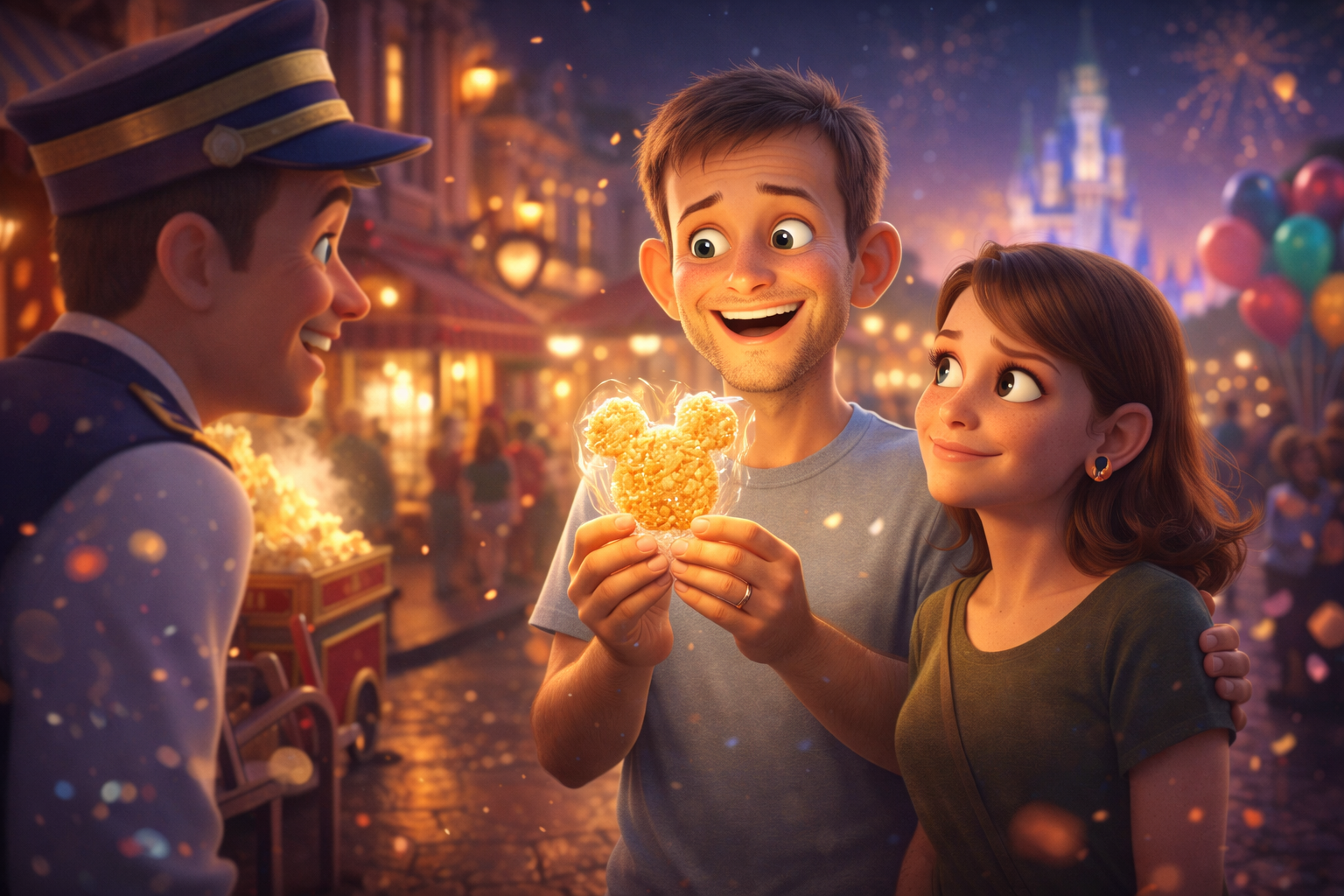
Because here's the thing: I wasn't buying a Rice Krispie Treat. I was buying a moment. Specifically, a moment on Main Street U.S.A. at Magic Kingdom, with the smell of fresh popcorn drifting past, Cinderella Castle glowing pink in the distance, and a cast member who'd just spotted my wife's birthday badge and wished her a happy birthday with a warmth so genuine it could melt a cynic at forty paces.
That moment? Worth every penny.
And that, my magnificent friends, is exactly what we're going to talk about today: the art of making your customers feel that your price isn't just fair — it's a gift.
Disney doesn't just charge premium prices. They make you grateful for the privilege of paying them. And the psychology behind how they do it? You can use it in your business. Starting tomorrow.
As Walt Disney himself once said: "Do what you do so well that they will want to see it again and bring their friends."
That "so well" is doing a LOT of heavy lifting in that sentence. Let's unpack exactly how. 🪄
Key Takeaways From This Article:
- Disney doesn't sell tickets — they sell emotional experiences, and that reframing is the foundation of all premium pricing.
- Price anchoring (showing the highest price first) makes every other option feel like a bargain. You can do this with your own service tiers.
- Bundling obscures individual costs and shifts the customer's focus from "how much per item" to "how much for the whole experience."
- The emotional context in which a price is presented matters more than the number itself. A £5 coffee at a beautiful café feels different from a £5 coffee at a petrol station.
- Disney's "Everything Speaks" philosophy means every detail — from how clean the toilets are to how staff greet you — reinforces (or undermines) your right to charge premium prices.
- Loss aversion is your friend: once customers have invested time, emotion, or money, they'll spend more to protect that investment.
- Language shapes price perception. "Guest" vs. "customer." "Experience" vs. "service." "Investment" vs. "cost." Choose your words carefully.
- The Bain & Company research shows that increasing customer retention by just 5% can boost profits by 25-95%. Disney builds its entire pricing model around getting you to come back.
- You don't need Disney's budget to use Disney's pricing psychology. You need Disney's mindset.
- The businesses that thrive on premium pricing aren't the ones with the best product — they're the ones with the best experience surrounding the product.
The Time Disney Charged Me $224 for a Single Day (And I'd Do It Again Tomorrow)
During our trip to Magic Kingdom in October 2023, I made the mistake of looking at my bank statement after the first day.
$224 for a single-day park ticket. Each. For the two of us, that's $448 just to walk through the gates. Before food. Before souvenirs. Before whatever absurdly overpriced collectible popcorn bucket I'd inevitably convince myself I needed.
(For my fellow Brits: that's roughly £360. For a day out. My wife could get a long weekend in Mallorca for that, and she reminded me approximately seventeen times.)
But here's what happened inside those gates.
Within the first ten minutes, a cast member at the entrance noticed my wife's anniversary badge and stopped — genuinely stopped what she was doing — to wish us happy aniversary by name. My wife got a special sticker and a wave from Pluto who "just happened" to be walking past.
My wife — a woman who prides herself on being impossible to impress — actually beamed.
Over the next twelve hours, we rode Space Mountain twice, watched the Festival of Fantasy parade from a spot a cast member quietly guided us to ("This is the best view — trust me"), ate dinner at Cinderella's Royal Table inside the actual castle, and ended the night watching fireworks on Main Street with my wife leaning against my shoulder, her Mickey ears slightly askew, holding a cocktail from a bar I'm fairly sure didn't exist on our last visit.
Was it expensive? Outrageously.
Would I do it again? I'm already planning next year.
And THAT is the power of pricing psychology done right. Disney didn't just charge me $224. They gave me a story I'll tell for the rest of my life. The price became a footnote. The memory became the headline.
Lee Cockerell — the chap who ran Walt Disney World operations for a decade, managing 40,000 cast members across 20 hotels and four theme parks — puts it perfectly. He says pricing is truly about value: "It's not the burger, it's how great is the burger."
Your business isn't selling burgers. Or legal advice. Or plumbing. Or haircuts. You're selling how the customer feels when they interact with you. And when that feeling is extraordinary, the price becomes secondary.
So let me ask you this: what's the story your customers tell about your business after they've paid? Is it a story about the price? Or about the experience?
The Pricing Trick Disney Has Been Pulling Since 1971 (And You Probably Fell For It)
You're standing in a queue at Walt Disney World. Not for a ride — for tickets. You pull out your phone to check prices and see this:
- One-day Magic Kingdom ticket (peak Saturday in July): $209
- One-day Magic Kingdom ticket (quiet Tuesday in September): $139
- 7-day base ticket: $58 per day
Now, a perfectly rational human being would look at those numbers and think, "Right, September it is." But that's not what Disney wants you to think.
They want you to see $209 first. Because the moment your brain registers $209 as "what Disney costs," everything else looks like a screaming deal. Suddenly, $139 feels positively charitable. And $58 a day? That's less than a decent dinner out! For Disney! It's practically free!
This, you beautiful pricing novice, is price anchoring — and it's arguably the single most powerful pricing tool in your arsenal.
The Disney Institute — which trains thousands of executives every year in their approach to business — has built an entire framework around what they call "Guestology": the study of what guests expect, want, and value. And one of the core findings from decades of Guestology research is this: people don't evaluate prices in a vacuum. They evaluate them relative to something else.
That "something else" is the anchor.
Disney doesn't set their highest prices because they expect everyone to pay them. They set them so that everything below looks reasonable. It's the same reason estate agents show you the overpriced wreck first, and why every car dealership puts the fully-loaded model in the window.
Here's the part that'll make your head spin: a research paper published in the National High School Journal of Science found that price anchoring increases perceived value by 32%. That's not a marginal improvement. That's a third more value in your customer's mind, just by showing them a bigger number first.
How you can use this tomorrow:
If you offer three service packages, your premium package isn't there to sell — it's there to make your mid-tier package look brilliant. In my book, Walt's Way, I call this the "Cinderella's Castle Effect" — the thing everyone sees first sets the tone for everything else.
I worked with an accountant in Manchester last year who had a single price for his tax services: £600. We restructured it into three tiers: £1,200 (Premium — includes quarterly reviews, priority access, tax planning), £750 (Standard — annual accounts, tax return, two consultations), and £400 (Basic — tax return only). Guess which one 70% of his clients chose? The £750. Before the restructure, they'd have haggled the £600 down to £500. Now they're happily paying more — and feeling clever about it.
Disney character analogy: think of this like Remy from Ratatouille. On its own, a rat cooking your dinner is absurd. But placed in the right context — the bustling Parisian kitchen, the discerning critic, the pursuit of perfection — you don't just accept it. You're charmed by it. Context transforms everything. Including your prices.
Quick Quiz Time!
A customer asks about your pricing. Do you:
A) Immediately offer a discount to "win the deal" (bonus: throw in your firstborn child for good measure)
B) Quote your lowest price and hope they don't ask for anything better
C) Lead with your premium offering, explain the value at each tier, and let the anchoring effect guide them to the package that's right for them
If you chose C, congratulations — you've got the Disney instinct. If you chose A or B... well, there's always a career in hermit crab farming, I suppose.
What's the first price your customer sees when they interact with your business? Is it working for you, or against you?
The 5 Principles Behind Disney's "Shut Up and Take My Money" Effect
Right, then. Now we know about anchoring. But Disney isn't a one-trick pony. (They're more of a one-trick flying elephant. Dumbo reference. You're welcome.)
There are five key psychological principles working together to make Disney guests hand over their credit cards with something approaching enthusiasm. Let's break them down.
Principle 1: Bundle Everything. Obscure Nothing... Except the Individual Prices.
Disney's Magic Your Way pricing restructure — launched in the mid-2000s — was described by industry analysts as "Disney's Brilliant Price Hike." And it was. They reduced the sticker price of a complete 7-night vacation by 36%... while increasing revenue.
How? Bundling.
Instead of guests seeing: hotel ($2,100) + tickets ($800) + dining ($600) + transport ($200) = $3,700 of pain, they saw: Complete Magic Your Way Package: $2,400! One number. One decision. And inside the resort, with meals and transport "already paid for," guests spent freely on extras.
The Disney Institute calls this the "hassle-free experience" — remove every friction point, including the friction of repeated price decisions, and guests relax. Relaxed guests spend more. It's not rocket science. (Though Disney does have actual rockets. Space Mountain counts, right?)
Principle 2: Make the Emotional Context Bigger Than the Price Tag.
Oscar Wilde once said, "A cynic is a man who knows the price of everything and the value of nothing."
Disney makes sure you're never a cynic. Every detail — the music playing on Main Street, the scent of vanilla pumped through the vents on Main Street U.S.A., the spotless pavements, the cast member who notices your child is crying and materialises with a sticker — is engineered to make you feel something.
And when you're feeling something? You don't evaluate prices rationally.
This is Disney's "Everything Speaks" philosophy in action. Walt Disney himself established this: every sight, sound, smell, and interaction either adds to the magic or detracts from it. There's no neutral. At Disney, the pavement is part of the pricing strategy.
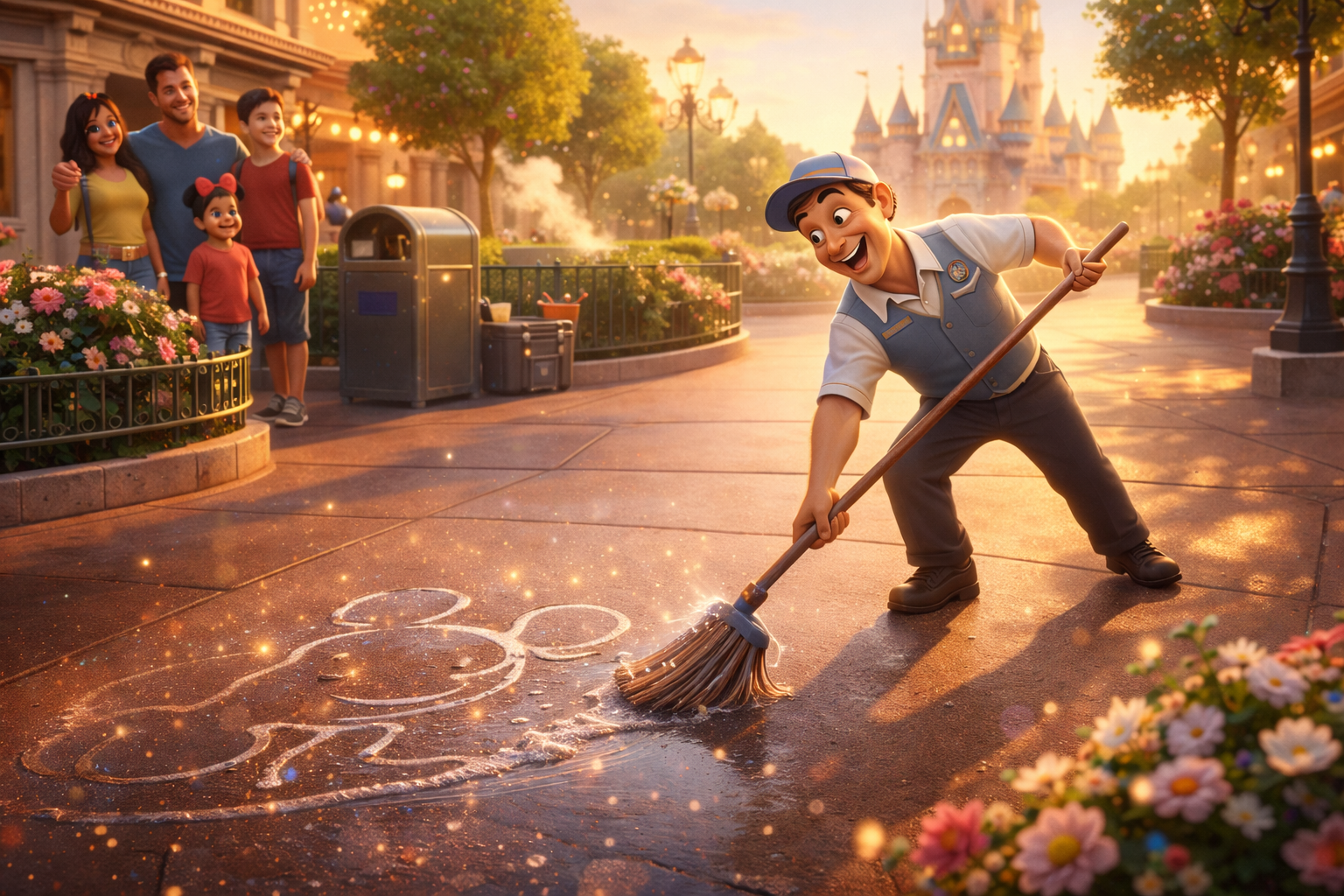
At Disney, they don't just clean the park. The cleaning crew — excuse me, the "custodial cast" — are trained to draw Disney characters in water on the pavement with their brooms. They're not cleaning. They're performing. And that performance makes you feel that $209 ticket was cheap.
Principle 3: Use Language That Elevates.
You're not a customer. You're a guest.
Staff aren't employees. They're cast members.
The theme park isn't a business. It's an experience.
This isn't just branding. It's pricing infrastructure. When you're a "guest," you expect hospitality, not a transaction. When someone is a "cast member," they're performing for you, not serving you. The language creates an emotional elevation that justifies premium pricing.
The Ritz-Carlton — another company famous for premium pricing — does the exact same thing: "We are ladies and gentlemen serving ladies and gentlemen." That single sentence justifies room rates three times the competition.
What language does YOUR business use? Are your customers "clients" or "valued partners"? Are your services "packages" or "solutions"? The words you choose are literally shaping what people are willing to pay.
Principle 4: Front-Load the Pain, Back-Load the Pleasure.
Disney is brilliant at this. You pay for your trip weeks or months in advance. By the time you arrive at the park, the financial pain is a distant memory. All that's left is joy.
Inside the park, MagicBand technology makes spending almost invisible. Tap your wrist. Don't think about it. The bill comes later. Much later. Possibly after you've already told everyone how magical the trip was.
This exploits two well-documented psychological effects: sunk cost acceleration (you've already paid, so you might as well enjoy everything) and the peak-end rule from Daniel Kahneman's research. People judge experiences by their peak moment and the ending, not the total. Disney engineers spectacular peaks (fireworks, character moments) and warm endings (cast members waving goodbye, "See ya real soon!").
The price? That happened at the beginning. The magic happened at the end. Guess which one you remember?
Principle 5: Make Coming Back Feel Like Coming Home.
"Now, you might be thinking, 'But Andrew, Disney can afford to invest billions in keeping people coming back. I run a carpet cleaning business in Wolverhampton!'"
Fair point. But the principle is the same.
Disney builds return visits into the DNA of the experience. Annual passes. Disney Vacation Club. The "we'll be back" feeling engineered into the farewell experience. And it works: Disney's strategy has been described by their own CFO, Hugh Johnston, as building "the habit of coming to Disneyland or Disney World, not one time, but multiple times."
The famous Bain & Company research — led by Frederick Reichheld, the chap who invented the Net Promoter Score — found that increasing customer retention by just 5% can boost profits by 25-95%. Disney doesn't need that study. They've been living it since 1955.
Quick Quiz Time!
When a customer complains about your prices, the best response is:
A) Apologise profusely and offer a discount so big your accountant weeps
B) Explain, in detail, your cost structure and overheads (because nothing says "value" like a spreadsheet)
C) Acknowledge the concern, then redirect the conversation to the value and experience they'll receive — show them what they're getting, not what they're paying
If you chose C, you're thinking like a Disney Imagineer. If you chose A or B... well, at least hermit crab farming has low overheads.
If you could change ONE word in your business — one job title, one service name, one way you describe what you do — to elevate how customers perceive your value, what would it be?
What Disney Does vs. What Everyone Else Does (And Why You're Probably in the "Everyone Else" Camp)
It's a Thursday afternoon and you're standing at the counter of your local coffee shop. You order a flat white. The barista looks like she'd rather be anywhere else. The cup has a lid that doesn't quite fit. The milk is lukewarm. The total is £4.80.
Now rewind. You're at the Polynesian Village Resort at Walt Disney World. You order a Dole Whip from a cast member who greets you with a smile so genuine you briefly consider adopting her. The cup is themed. The Dole Whip is perfect. Tiki torches flicker in the background. The total is $6.99.
One of these experiences made you feel ripped off. The other made you feel like you were on holiday in a Polynesian paradise.
The price difference? About two quid. The experience difference? A universe.
This is what most businesses get catastrophically wrong about pricing. They set prices based on costs, competitors, or gut feeling. Disney sets prices based on perceived value — and then engineers every detail of the experience to justify them.
Here's a real company that gets it right outside Disney: Zappos. The online shoe retailer doesn't compete on price — their prices are standard retail. They compete on experience. Free shipping both ways. A 365-day return policy. Customer service reps who are trained to make you feel like a human being, not a ticket number. Zappos was acquired by Amazon for $1.2 billion. Not because their shoes were cheaper. Because their experience was better.
The four things you can do this week:
Step 1: Audit your customer's emotional journey. Walk through your business as if you're a customer. What do you see, hear, smell, and feel? Disney calls this approach "Guestology" — studying the guest experience from arrival to departure. You should do the same.
Step 2: Find your "Main Street U.S.A." moment. What's the first thing customers experience? Disney puts Main Street — the most beautiful, immaculate, sensory-rich part of the park — right at the entrance. It sets the tone for everything. What sets YOUR tone?
Step 3: Create three pricing tiers. If you have one price, you have one conversation: "Is it worth it?" With three tiers (Basic, Standard, Premium), the conversation becomes: "Which one is right for me?" The Premium tier is your price anchor. The Standard tier is where most people will land — and they'll feel clever about it.
Step 4: Invest in the details that "speak." Disney's "Everything Speaks" philosophy means nothing is neutral. Your invoice design, your hold music, your email signature, the cleanliness of your reception area — all of it either supports or undermines your right to charge what you charge.
You don't need magic. You need mindset. And possibly a decent Dole Whip recipe.
Quick Quiz Time!
A new competitor opens near you with lower prices. Do you:
A) Panic. Drop your prices. Start a price war. Cry into your reduced-margin profits.
B) Ignore them completely and hope customers value loyalty. (Spoiler: hope is not a strategy.)
C) Double down on your experience, communicate your unique value clearly, and let the competitor compete on price while you compete on worth
If you chose C, you're channelling Simba in The Lion King — reclaiming your rightful place. If you chose A... well, even Scar had a brief run as king. It didn't end well.
What's one detail in your business that's currently "speaking against you" — undermining the value you deliver? How could you fix it this week?
The Small-Town Restaurant That Out-Disneyed Disney
I worked with a coaching client a couple of years ago — a family-run Italian restaurant in a small town in Somerset. Lovely food. Terrible pricing.
They were charging £9.95 for a main course because the Italian down the road charged £10.50 and they wanted to be "competitive." The problem? They were racing to the bottom. Margins were razor-thin. The owner, Marco, was working 80-hour weeks and barely covering costs.
Here's what we did.
First, we changed the language. The menu went from "dishes" to "Marco's family recipes." Each item got a two-line origin story: "My nonna taught me this recipe in her kitchen in Naples. She'd be furious if she knew I was sharing it." Immediately, you're not ordering spaghetti Bolognese. You're ordering a piece of Marco's family history.
Second, we created three dining experiences: The Classic (£14.95 — choose any main), The Full Italian (£24.95 — antipasto, main, dessert, and a glass of house wine), and Marco's Table (£39.95 per person — a five-course tasting menu, served by Marco himself, with wine pairings and stories about each dish).
Third, we invested in the details. Fresh flowers on every table. Italian music. Marco greeting every guest personally. A handwritten thank-you card with the bill.
The results?
Average spend per head went from £14 to £27 within three months. Marco's Table was fully booked every Friday and Saturday within six weeks. And here's the best part: not a single customer complained about the prices.
They weren't paying more for food. They were paying for an experience. An evening out that felt special, personal, and worth telling friends about.
Three lessons from Marco's kitchen:
- The story IS the price justification. Marco's nonna recipe isn't "better" than a generic Bolognese. But it means more. And meaning drives willingness to pay.
- Three tiers changed the conversation. Nobody argued about whether £14.95 was "worth it" because they were too busy deciding between The Classic and The Full Italian. The decision shifted from "should I?" to "which one?"
- Details compound. Fresh flowers cost £30 a week. Handwritten cards cost pennies. Italian music costs nothing. Combined, they created an atmosphere that justified a 90% increase in average spend.
As Maya Angelou beautifully put it: "People will forget what you said, people will forget what you did, but people will never forget how you made them feel."
Disney knows this in their bones. Marco learned it. And you can too.
From Dentists to Dog Groomers: How This Works in Any Industry
"But Andrew, I'm not selling Italian food or theme park tickets. I'm a dentist/plumber/accountant/dog groomer/IT consultant."
I hear you. And here's the good news: Disney's pricing psychology works in EVERY industry. The tactics are universal. Only the details change.
Retail: A boutique clothing shop I coached created three "styling tiers" — Self-Select (browse freely), Styled Pick (curated rack based on your style profile), and VIP Styling Session (one-on-one with the owner, champagne, personal fitting). Same clothes. Three completely different experiences. Average basket value doubled.
Professional services: A law firm stopped quoting hourly rates and started offering "certainty packages" — fixed-fee bundles that included all calls, emails, and consultations. Clients stopped clock-watching and started trusting. Revenue went up 25% in the first year.
Health and wellness: A physiotherapy practice I worked with introduced a "Recovery Journey" package — initial assessment, treatment plan, six sessions, and a follow-up review. Instead of £45 per session (which felt transactional), it was £249 for the journey (which felt like a partnership). Retention tripled.
Trades: An electrician in Leeds started sending a thank-you text the day after every job, along with a photo of the completed work and a one-year guarantee card. Cost: nothing. Impact: referrals up 40%, and not a single customer has questioned his prices since.
Online businesses: A SaaS company restructured from one price to three tiers, with the top tier named the "Enterprise" plan at four times the price of the basic. The middle tier — their target — saw a 35% increase in sign-ups. The Enterprise plan? It barely sold. It wasn't supposed to. It was the anchor.
As Walt Disney once said: "It's kind of fun to do the impossible." And charging premium prices in a world that tells you to compete on cost? That sounds pretty impossible to most business owners. But when you understand the psychology, it becomes entirely possible — and genuinely fun.
Quick Quiz Time!
You're a plumber. A customer asks why your callout fee is higher than the competition. Do you:
A) Explain that you have higher overheads because your van is newer (fascinating)
B) Match the competitor's price and silently resent every minute of the job
C) Explain that your fee includes a full system check, a written report, a one-year guarantee on all work, and a follow-up call to make sure everything's working — and that your Google reviews speak for themselves
If you chose C, you're the Buzz Lightyear of plumbing — going to infinity and beyond. If you chose A or B... to infinity and the bargain basement, more like.
Why Playing the Long Game Beats Winning the Price War (Every Single Time)
Here's a number that should make you sit up: Walt Disney World welcomed approximately 49 million visitors in 2024. That's more than the population of Spain. Pouring through four theme parks. Year after year.
And here's the really extraordinary part: Disney's theme park admissions revenue was $11.1 billion in 2024. Up 7% from the year before. At a time when attendance was essentially flat. They earned MORE money from roughly the SAME number of people.
That's not luck. That's pricing psychology compounding over decades.
The long-term benefits of getting your pricing right — the Disney way — go far beyond this quarter's profits:
Customer loyalty intensifies. When people feel they're getting extraordinary value (not the cheapest price, but the best value), they don't just come back. They become advocates. They tell friends. They write reviews. They become part of your marketing team, unpaid and enthusiastic.
Price sensitivity decreases over time. Disney has raised ticket prices more than fifty times since 1971. That original $3.50 ticket is now $209 on peak days. A roughly 6,000% increase — massively outpacing inflation. And people still queue up. Because each price increase was accompanied by investment in the experience that justified it.
Your margins improve WITHOUT increasing volume. This is the holy grail. Disney's 2024 results prove it: flat attendance, record revenue. By investing in per-guest value rather than chasing volume, your business becomes healthier, more sustainable, and less exhausting to run.
You attract better customers. I don't mean "richer" customers. I mean customers who value what you do. Premium pricing naturally filters for people who appreciate quality. These customers are easier to serve, more loyal, more forgiving of occasional mistakes, and more likely to refer others like themselves.
Disney magic isn't about deep pockets. It's about deep caring. About every single detail. About making every guest feel that the price they paid was the best investment they made all year.
Quick Quiz Time!
When it comes to pricing strategy, the biggest long-term risk is:
A) Charging too much and losing some customers (terrifying!)
B) Never raising your prices because you're afraid of the reaction (noble! Also bankrupt.)
C) Failing to invest in the experience that justifies your prices — because without the experience, the price IS the only thing customers can judge you on
If you chose C, you understand the Disney principle at its deepest level. If you chose B, I have a phone number for a very understanding accountant. You're going to need one.
The Honest Bit: Where This Can Go Wrong (Even Disney Gets It Wrong Sometimes)
Right. I'm not here to rain on your magical parade, but I'd be a terrible coach if I didn't give you the reality check.
Disney's pricing isn't perfect. In fact, it's facing real criticism. A Wall Street Journal report in early 2025 highlighted that Disney's own internal surveys show a sharp downward trend in "intent to return" among guests, starting in late 2023. That LendingTree survey I mentioned? The one showing 45% of families going into debt for a Disney trip? That's not a good look.
Disney knows it. CFO Hugh Johnston has publicly acknowledged the importance of making Disney vacations affordable enough to be a "habit" rather than a "one-time splurge."
The lesson? Premium pricing only works when the value keeps pace with the price. The moment the price outstrips the experience, you lose trust. And trust, once lost, is harder to rebuild than Cinderella's Castle after a hurricane.
Here are five honest strategies for navigating the challenges:
1. Start small. Don't triple your prices overnight. Introduce tiers gradually. Test one premium option alongside your existing offerings. See how customers respond.
2. Invest before you inflate. Raise the experience first, then the price. Disney added Galaxy's Edge ($1 billion investment) before raising ticket prices. They earned the increase. You should too.
3. Be transparent about value. Don't hide behind fancy language if the substance isn't there. Customers aren't stupid. They'll pay premium prices gladly — but only if they can see and feel what they're paying for.
4. Watch your retention numbers. If repeat business drops after a price increase, that's your canary in the coal mine. The price is ahead of the experience. Fix the experience, or pull back the price.
5. Remember: some customers aren't your customers. Disney has accepted that not every family can afford their parks. That's a conscious business decision. You may need to make the same one. Your ideal customer is the one who values what you offer. Not the one who wants what you offer at someone else's price.
As Mary Poppins would say: a spoonful of reality helps the pricing go up. (I'm paraphrasing. Slightly.)
Quick Quiz Time!
You've raised your prices and one customer complains loudly on social media. Do you:
A) Immediately reverse the increase and issue a public apology (congratulations, you've just trained all your customers to complain on social media)
B) Ignore it and hope it goes away (ah, the "ostrich strategy" — bold)
C) Respond warmly, acknowledge the concern, explain the value you've added, and offer to discuss it personally — while holding firm on the price that reflects your quality
The answer, as always, is C. Channel your inner Elsa. Let it go. Not every customer needs to agree with your pricing. The ones who matter will.
Your Burning Questions, Answered (With Disney References, Obviously)
Q: "Won't premium pricing drive away customers?"
Some? Yes. And that's okay. Disney drives away some customers with $209 tickets. But the ones who come are more valuable, more loyal, and spend more per visit. When I coach businesses at Help My Business, I always say: premium pricing doesn't reduce your customers — it curates them. You want Woody-level loyalty, not Lotso-level fickle. (If you got that Toy Story reference, we're friends now.)
Q: "How much should I actually raise my prices?"
The Disney answer: raise them as much as you can justify with experience. The practical answer: start with 10-20% on your most popular offering, but ONLY after you've made a visible improvement to the experience. Customers forgive price increases when they can see where the money went. Like the Beast's magical rose — the value must be visible.
Q: "My competitors are all cheaper than me. Isn't that a problem?"
Only if you're competing on price. If you're competing on experience, cheaper competitors are actually your allies — they're anchoring the market LOW, which makes your premium positioning even more distinctive. Starbucks doesn't worry about the instant coffee aisle. Disney doesn't worry about the local fairground. Be the Disney in your industry, not the dodgems. 🤔
Q: "How do I convince my team to support higher prices?"
This is where Disney's operational model is genius. At Disney, every cast member — from the person sweeping Main Street to the VP of Operations — understands that their job is to justify the price through the guest experience. Lee Cockerell created the Disney Great Leader Strategies specifically to train the 7,000 leaders at Walt Disney World in this mindset. You need to do the same: make every team member understand that their role is to make the customer's experience worth every penny.
Q: "What if my industry doesn't lend itself to 'experiences'?"
With respect: every industry lends itself to experiences. A plumber who shows up on time, wears shoe covers, explains what they're doing, cleans up after themselves, and sends a follow-up text is delivering an experience. A dentist who remembers your daughter's name, plays your favourite music during treatment, and sends a handwritten birthday card is delivering an experience. Experience isn't about spectacle. It's about care. And care is free.
Q: "How long before I see results from changing my pricing approach?"
In my coaching experience? You'll see the impact within 30-60 days of implementing tiered pricing. The shift in customer perception takes longer — three to six months of consistently delivering on the elevated experience. Rome wasn't built in a day. But Disneyland was built in one year. (365 days from groundbreaking to opening in 1955. Walt was not a patient man.)
Putting It All Together: Your Pricing Transformation Starts Now
We've come to the end of our magical journey together, and I hope your brain is buzzing with ideas.
Here's what we've covered: Disney doesn't charge premium prices because they have a castle and a talking mouse. They charge premium prices because they've mastered the psychology of making every single guest feel that the price was the least important part of the experience.
They anchor high so everything else feels reasonable. They bundle to remove the pain of itemised decisions. They elevate with language that makes you feel like a guest, not a wallet. They front-load the payment and back-load the magic. They invest relentlessly in the details that "speak." And they build everything — everything — around the question: "How do we make them want to come back?"
In my thirty-odd years of coaching businesses, from one-person startups to companies with hundreds of employees, the single biggest lever for profit growth is almost never "more customers." It's almost always "more value per customer." Disney proves this every single year.
So here's my challenge to you: this week, pick ONE thing from this article and implement it.
Maybe it's creating three pricing tiers. Maybe it's changing one word in how you describe your service. Maybe it's auditing your customer's emotional journey and finding the one detail that's "speaking against you."
Whatever it is, do it. Start small. But start.
Because Disney magic isn't about having a castle or a talking mouse. It's about creating moments of wonder in the everyday. And your business — yes, YOUR business — is capable of exactly that.
As Walt Disney once said: "All our dreams can come true, if we have the courage to pursue them." 🌟
Including the dream of charging what you're truly worth.
Now go sprinkle some pixie dust on those prices.
About the Author
Andrew Lock is a renowned business coach, consultant, and author with over three decades of experience helping entrepreneurs and business leaders achieve extraordinary success. As the founder of 'Help My Business!', Andrew has empowered thousands of business owners worldwide through his unique coaching, mastermind groups, 10 best-selling books, and engaging keynote presentations.
Known as the "The Yoda of marketing," (without the green pointy ears), Andrew brings a refreshing blend of humor and practical insights to his work. His expertise spans customer experience, pricing, sales, marketing, employee management, and operations, with a special focus on applying Walt Disney's business principles to modern enterprises.
Andrew is the author of ten books, including the popular "Walt's Way" and "Big Lessons from Big Brands." His work has been featured in major media outlets, and he's shared stages with business luminaries like Sir Richard Branson, Donald Trump, Daymond John, Dan Kennedy, The Dalai Lama, and Michael Gerber.
When he's not helping businesses transform their customer service, Andrew enjoys traveling with his family and indulging in his passion for all things Disney and chocolate (though not necessarily in that order).
For more insights and resources, visit www.AndrewLock.com.
Want to go deeper? Here are a few of the books and resources I referenced (or shamelessly stole ideas from) while writing this:
- Be Our Guest — Disney Institute (the closest thing to a Disney customer service bible — and the origin of "Guestology")
- Creating Magic — Lee Cockerell (the chap who ran Walt Disney World operations for a decade — his perspective on pricing and value is gold)
- The Ride of a Lifetime — Bob Iger (fascinating insight into Disney's brand and investment strategy)
- Walt's Way — Andrew Lock (yes, it's my book — but it covers Disney's business principles in depth, including pricing)
- The Bain & Company customer retention research by Frederick Reichheld — specifically "Prescription for Cutting Costs" and "The Value of Keeping the Right Customers" (Harvard Business Review)
